Sunday, 29 December 2024

Mam Tor and the Broken Road

I was in the southern Peak District in late September, pitched at the Carsington Water Club Campsite, just above Carsington Water itself, a large reservoir filling a valley, with a long wide dam topped by a cycleway and footpath, and a good road running below them. As well as holding a vast amount of water, it serves as a general leisure facility for the south-eastern Peak District. 

It was a nice Caravan Club site, set in pine trees, with glimpses of the Water below. I'd go there again, but not in the autumn. Wind and rain while I was there brought down plenty of pine needles that covered car and caravan, and were very tedious to brush off. They got into all of Sophie's upper-surface crevices, and a few were annoyingly tricky to winkle out. Indeed one or two are still lodged there. But otherwise I enjoyed my week in the Peak District, even if half the time the weather wasn't great. 

There was a lot to see, if you appreciated dramatic rocky ridges, deep wooded valleys, and rolling farmland. There were historic towns and villages; many industrial locations connected with lead mining, or cotton milling; and one or two Victorian spas, the chief one being Buxton, which actually had an opera house. There were fine churches: those at Ashbourne, Wirkworth and Ilam stand out in my memory, but of course I didn't get to see more than a few. There were prehistoric stone circles and preserved steam railways. The walking was of course superb, whether you followed old railway lines, tumbling rivers, or high rocky ridges. Indeed, there were strange rock formations all over. The geology must be fascinating. This was where Blue John, the prized decorative mineral, comes from. 

I was last here in November 1996, twenty-eight years ago, with Mum, Dad and M---. I hadn't returned since, partly because the Peak District was not on my direct route to Northumberland or Scotland. Sticking to the fast A1/A1(M), I always by-passed it to the east. Apart from that, it seemed hedged in by the big cities of the North, and I don't care overmuch for big cities. With the personal experience of London in mind, I imagined hoards of urbanites swarming into all parts of the Peak District, most of the time, compromising its allure. So I stayed away. Once or twice in recent years I'd actually booked a few days at Carsington Water, or at Belper, only to change my plans and go somewhere else. I seemed fated to always do that. 

But this year I finally managed it. As I said, a full week: but it turned out to be insufficient for more than a superficial exploration. As for the notion that the Peak District is besieged and overwhelmed by day trippers from Manchester, Huddersfield, Bradford, Leeds, Wakefield, Barnsley, Sheffield, Nottingham, Derby and Stoke-on-Trent - well, I was wrong. They may have been there, but were all swallowed up by the scenery. To be sure, I encountered many people along the prime walking spots and at the must-see tourist spots; but elsewhere I found space and solitude. 

I did what I wanted to do. And I still couldn't see more than a fraction of it all. I'll have to go back. I will say, though, that I did not enjoy my initial approach through the western suburbs of Derby. Whatever Derby's city-centre charms, its outskirts were humdrum and dull. And yet, coming from the East Midlands, I could scarcely avoid Derby. Oh well. Next time, a different route, even if it adds mileage. 

On this first revisit, it was important to take another look at places I'd seen with my parents and friend back in 1996. One of them was Mam Tor. This famous peak commanded a superb view to the north-west over Edale head to the flat top of Kinder Scout, to the north-east down Edale, and to the south-east to Castleton and Hope. It was an unmissable viewpoint, but it involved a stiff climb from its lower slopes to the windy summit. The climb was a simple upward slog, but it wasn't for the unfit or disabled. So Mum and Dad, then in their later seventies, were not up for it, and remained in the car below. They still had a great lower-level view. 


That silver speck in the bottom of the shot above was Dad's car.

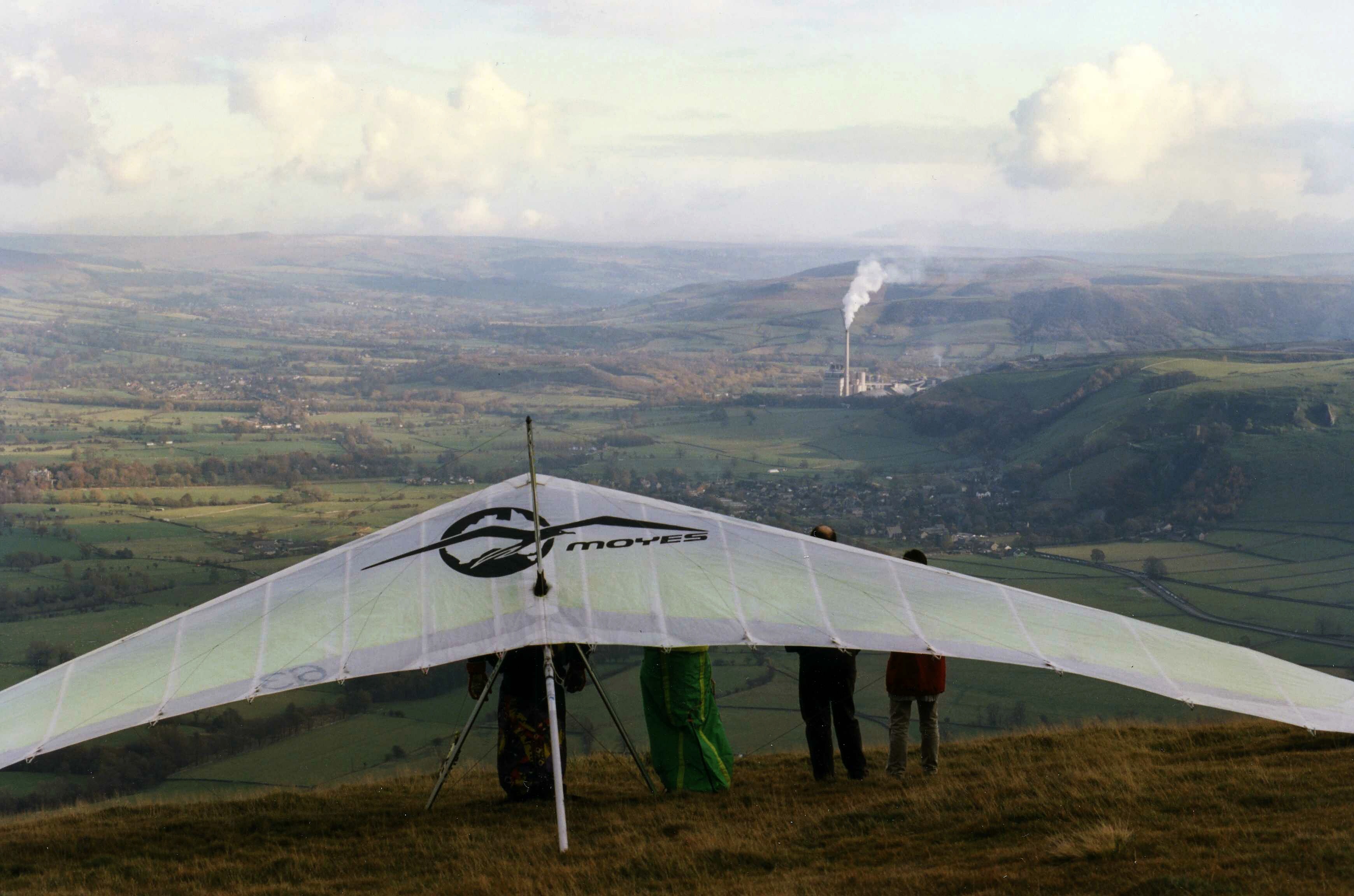
Mum and Dad professed themselves quite happy to do crosswords while M--- and I tackled the steep path upwards. We were then in our forties, and as spring-footed as gambling lambs, and we happily made the ascent. We were amply rewarded with views to die for. Many others were up there too, taking in Edale and the surrounding hills. It was clearly a top spot for hang-gliding too. Here are some pictures from 1996, to show what I mean.


The summit of Mam Tor had once been a pre-Roman hill fort - a great place to light a fire-beacon from - so there were worn-down earth ramparts with a rounded centre. Mind you, a bleak spot for the inhabitants. I bet they huddled into their cloaks, and invented all sorts of excuses to stay in their huts and out of the winter wind! Some of this ancient fort had disappeared, for on its south-east side was a sheer cliff, the entire face of the hill having slipped downwards in a massive landslide that was still moving. Geology was slowly making Mam Tor collapse into the valley below. This was the 1996 view, as near to the edge as I dared:   

Well, it was now 2024, and Mum, Dad and M--- had gone from my life many years previously. I was on my own, and in my early seventies. There would be no reprise of that 1996 ascent! My right knee wouldn't be up to it, even with a stick. It wasn't so much the going up to the top: it was the coming down. But Mam Tor still drew me like a magnet, and I was determined to at least photograph what I could. Here's a selection of the lower-slope views, taken with both LXV and my phone. 


What did the landslip look like now? You had to divert onto the old A road to see. This originally replaced the very steep and rather narrow road that came up from Castleton through nearby Winnats Pass. The newer road zig-zagged upwards in a series of hairpin bends, but it had much easier gradients for the important east-west traffic that used it, at first horse-drawn but latterly motorised. From 1922 it was called the A625. But as it was constructed on unstable ground that kept slipping downwards, it needed constant repair. The cost of that, and the inconvenience of the necessary road closures, eventually became too much and the route was abandoned. For a while, the A625 had two disjointed halves, with an unclassified section in the middle - the bit that hairpinned under the sheer face of Mam Tor. There's a a similar situation with the A3055 on the south of the Isle of Wight, where persistent undermining and slippage of the road from springwater lubricating the clays and shales thereabouts has led to the complete closure of a section of the A3055, and its reduction to a fenced-in footpath, so that vehicles cannot get through any longer. As at Mam Tor, an unclassified road on much firmer ground away from the slippage point substitutes for the 'proper' route.

This is the 'footpath' section of the A3055, in this 2019 shot of mine:


It's all massively inconvenient for residents and delivery drivers, of course. And no buses pass by any more. The main worry must however be whether there is any long-term future for the homes built on the unstable land between the inland 'cliff' and the sea. Homes like this:


Back to the A625 story. Eventually, the damaged and downgraded remains of the A625 became impassable for ordinary vehicles. The slipping ground buckled and broke up the much-patched surface, then turned it into a contorted wreck, useless for all but walkers who don't mind a scramble.

Well, this would be something new to see. How bad was the destruction? It was easy enough to drive past the Blue John Cavern entrance (still a tourist attarction) and park Sophie. MamTor loomed up ahead, rather threateningly I thought, as if thinking of toppling onto any inquisitive but rash human beings who dared to get too close. Not a safe spot in very wet weather, I thought. How would you ever get out of the way of another big landslip?


But the thing that really caught my eye was the shocking state of the old A625. A testament to the inexorable power of nature! An earthquake could hardly have done more to destroy the road surface. I took a couple of shots from a short distance. 


Should I approach more closely? I decided not to. I wasn't dressed nor shod for rough ground, and I didn't relish the consequences of an accidental stumble. Besides, it might tempt Mam Tor too much. No, best to get away while I could.   

But I'll be back.

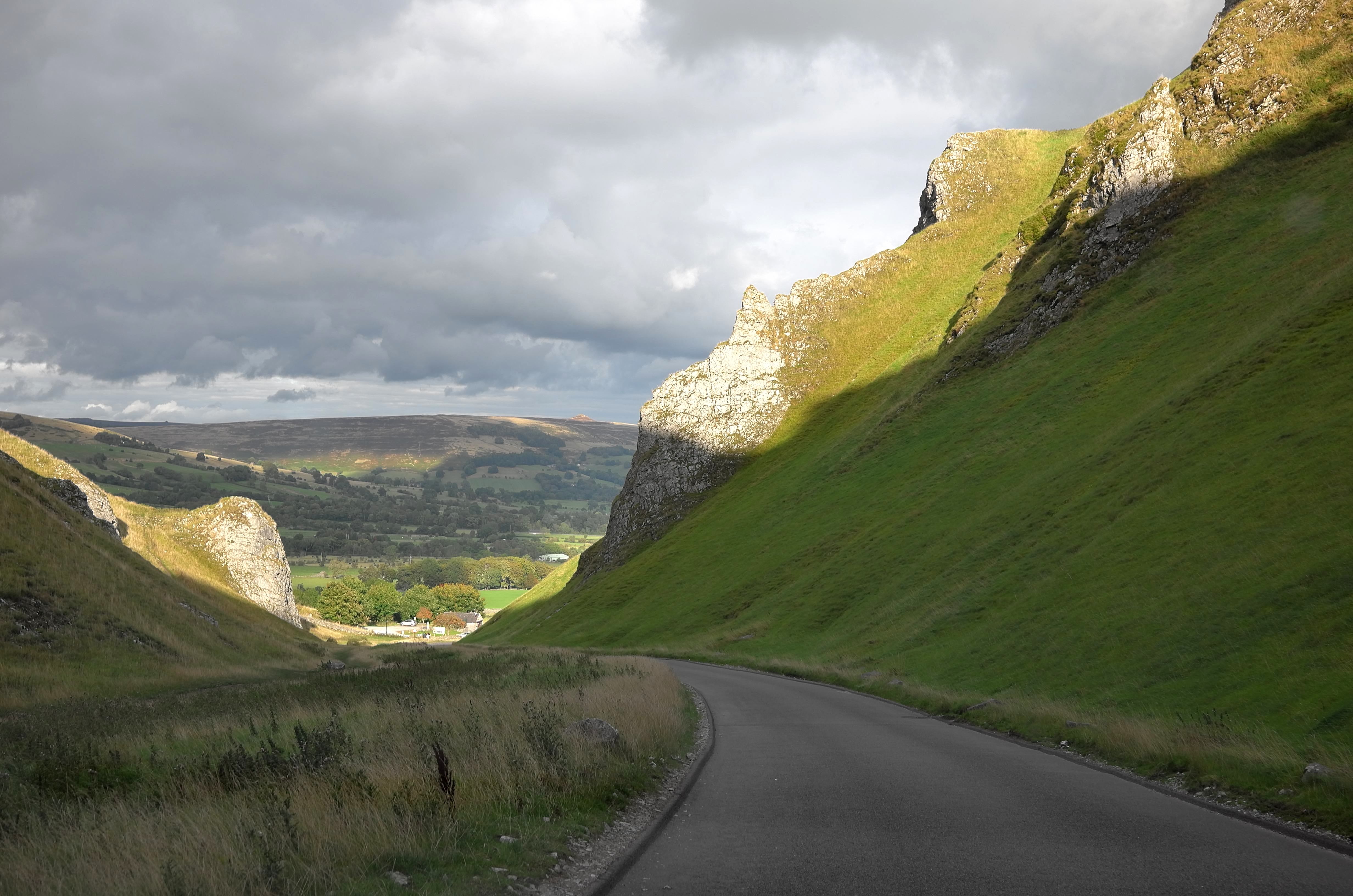
If I didn't attempt another climb to the top, I did at least have the thrill of driving Sophie through Winnats Pass. This, as I said, was the original route past Mam Tor, but with the serious drawback that it was very steep. As steep and twisting as some passes in the Lake District? As scary as coming down from the Long Mynd in Shropshire? Well, maybe not quite so bad. The experience is short, and the road is wider and better-surfaced. There's no feeling that one could easily get out of control and fall into an abyss. But it is certainly a test of one's engine and gear-changing going up, and of one's brakes going down. The Pass needs care and attention both ways. But I had complete faith in Sophie. I intended to stop once or twice on the way down, if I could find the right places, and take pictures of the Pass.

Well, the traffic was light. I managed to stop safely, getting in nobody's way, and secured several shots in sunlight. They do at least show how scenic the Peak District can be.


If you would like to give me feedback on this post, or make an enquiry, please email me from my Blog Profile.

Sunday, 15 December 2024

Maybe I need not worry about the Windows 10 support withdrawal

Only ten months now before Microsoft turns off support for Windows 10. 

MS has been hustling every user of Windows 10 (and earlier versions of Windows) to upgrade to Windows 11. I gather that the latest OS is awkward to use in some respects, and is not popular. But in any case, the new architecture that comes with Windows 11 means that older devices - and some bought only a couple of years ago - cannot run it. So 'upgrading' involves buying a new laptop or desktop device at considerable expense. 

This, understandably, is unwelcome to a lot of people. There is resistance. In my own case, my present laptop - a Microsoft Surface Book that was posh and fairly cutting-edge in 2016 when I bought it, and is still working perfectly well - is stuck with Windows 10. I can't install Windows 11 on it. So what should I do?  

In the immediate period, there's nothing I can do. The money I'd set aside for a replacement laptop sometime in early 2025 - £2,500 - has been swallowed up by dental treatment and some other necessary things. I can't conjure up further cash, because my savings accounts are depleted, and replenishment is slow while the monthly car repayments persist. I can't do it all. 

The car repayments end in October 2026, but I need not wait until the hire-purchase balance reduces to absolutely nil. It'll be financially safe to buy a new laptop sooner, in mid-2026. I could treat myself to a shiny new Surface Book (or something of similar refinement) for my 74th birthday in July 2026. But that's still a year and a half away. Will I be exposed to online security threats from October 2025 to July 2026? It's a concern.

MS have said that they will continue to support Windows 10 after October 2025 if a user pays for hitherto-free security updates. I should therefore be able to buy a year's cover. I don't know what the cost will actually be. If only £30, it's probably a no-brainer. But MS will have a gun at users' heads, and may feel that they can ask for £100, or even £150. If they do, I'll be wondering whether I can instead rely on my Android phone for all Internet access, and use the laptop offline-only.   
But now a thought has occurred to me. Both phone and laptop are currently protected by my annual F-Secure antivirus and malware subscription. That would continue for at least the phone. So if, as now, I tethered the laptop to the phone, wouldn't I be safe, even without Windows 10 security updates? In other words, wouldn't the phone trap incoming viruses and malware, and not send them on to the laptop? 

I have researched this a bit. I've read that viruses and malware designed to exploit vulnerabilities in Android will do nothing to a Windows device, as the OSs are so different. The harmful code should just lie in the laptop, unable to do anything. And that if there is extra protection (F-Secure's software in my case), then malicious code will be neutralised or expunged on the phone before it even crosses over to to the laptop. This is reassuring. I do hope it's true. But there are other points to make. I don't surf the web indiscriminately. I take care, and stick to 'proper' websites (F-Secure vets them for me; so indeed does Google itself). Furthermore, I'm not on any kind of social media, which drastically reduces my risk of getting into difficulties. And in any case, most of the time I use the laptop offline, predominately for photo-editing. 

So to conclude, I think that after the plug is pulled on Windows 10 in October 2025 I will still be able to use my now-elderly laptop to safely access the Internet, providing I do it through the phone, and not directly. Just as if I were away on holiday. 

Mind you, I will definitely look forward to having a modern laptop during 2026, simply to have more speed, and perhaps a larger screen. A faster machine will improve my photo-editing workflow, and greatly speed up my backups to external storage media. 

But I can wait for the right machine, purchased at the right moment. 

If you would like to give me feedback on this post, or make an enquiry, please email me from my Blog Profile.

Saturday, 7 December 2024

A horn for Christmas

Christmas Markets have long been very popular. I quite like them. They are so atmospheric, especially once it starts to get dark. And opportunities to take great photos abound, whether it's pictures of the stalls or the merry throng of people stopping to see what the traders are selling. Occasionally there will be an unmissable shot - for instance this one, which I took at Winchester Christmas Market next to the Cathedral in 2011. The stall was a 'live' display of the nativity scene, complete with a goat (I think it's a goat). I can't remember what Mary and Jesus were doing at the time, but here's Joseph on his mobile phone, to God presumably. I captioned the photo thus: Joseph queries surprise baby with Higher Authority. 


It's the incongruity of the phone, of course, that makes the picture. But supposing they did have phones back then, it would still have made a good shot because I'm not sure that Mary would have prepared Joseph for the arrival of a holy child. How could she possibly explain it? 'Oh by the way, Joe, the Archangel Gabriel popped by while you were out, and as a result I'm pregnant! Isn't that incredible?' It might not have gone down well. So she'd keep silent until the birth was imminent, and only then explain. But it would turn out fine. Before Joseph could ask probing questions or express any misgivings, a super-bright star would flare in the sky, amazed shepherds would knock on the door, three richly-clad kings from the Orient would arrive with gifts, all the animals in the stable would cluster around the glowing cradle, and a heavenly chorus would sing loudly. Joseph would naturally take all these things as infallible signs of divine intervention. Wouldn't you? But later, when he had a quiet moment, he might have given Heaven a bell, just to check that this was all kosher, and that there was no mistake. And I've caught him making that call.

This year I was at the Christmas Market in Canterbury with my cousin Rosemary. The usual scenes.


But we saw one stall we hadn't seen before. The man was selling goods fashioned from animal horns - drinking horns mainly, but all kinds of other articles, some decorative, some useful, but all rather attractive.


It was fascinating to look at. The horns were real, with natural patterns on them. And we were assured that they were, in the main, cow horns from Africa. Neither of us knew enough about African cows to dispute that. Certainly they weren't rhino horns. We both ended up wanting to buy something. I chose a shoe horn costing £8. Though a humble purchase, it was a thing of beauty. The man wrapped it up carefully in tissue paper. 

I use a shoe horn pretty well daily, to get lace-up leather shoes and boots on, and I already had a perfectly good plastic shoe horn that I bought from Timpson the shoe repairers in 2023. That would now become my spare. Henceforth, I'd make this posher version - made, as I said, from the horn of an African cow - my number one shoe horn, the one I'd carry around in my bag. 

Back home, I unpacked it and inspected it more closely. I hadn't been diddled. It really was cut and shaped from a piece of natural horn. Its surface was smooth and polished, but with little bumps and some pitting, which I don't think would have been present if just a moulded plastic shoe horn. It was slightly translucent, as I could see by holding it against a light. 

Next morning, in daylight, I had an even closer look. 


LXV (my Leica X Vario camera) has reproduced the colours precisely. I think it looks very attractive indeed, a feast for the eye, particularly on the convex side (the lower shot). 

Here it is, compared to the now-superseded plastic Timpson shoe horn.


They are almost the same size, seven inches long. The new shoe horn is slightly heavier, but also more substantial, and likely to last longer. Although functionally no better than the plastic Timpson article, the African Cow version wins hands down for looks and style, in my opinion. 

The natural pattern on each side of the new shoe horn reminded me of some photos I'd taken. For example, these recent shots of a sunset at Shoreham.


But more especially of the subtle colours that gradually developed during a sunrise in New Zealand in 2007, at a little place called Karitane, on the coast north of Dunedin, in South Island. I can't help showing the entire sequence of pictures. It was such a lovely sunrise. These were not Leica shots. I was using a Canon G6 compact zoom camera, with a sensor of only 7 megapixels. But didn't it do well.


In the last shot, you can see where we had parked the campervan overnight, at the head of a little beach, right by the tidal water. I remember hearing the roar of the tide only feet away from the campervan during the night. But it was the spectacular dawn that I most wondered at. And some of those colours are reproduced in my new shoe horn.

In some ways the shoe horn also conjures up the appearance of certain shells, and mother-of-pearl. New Zealand in 2007 again.


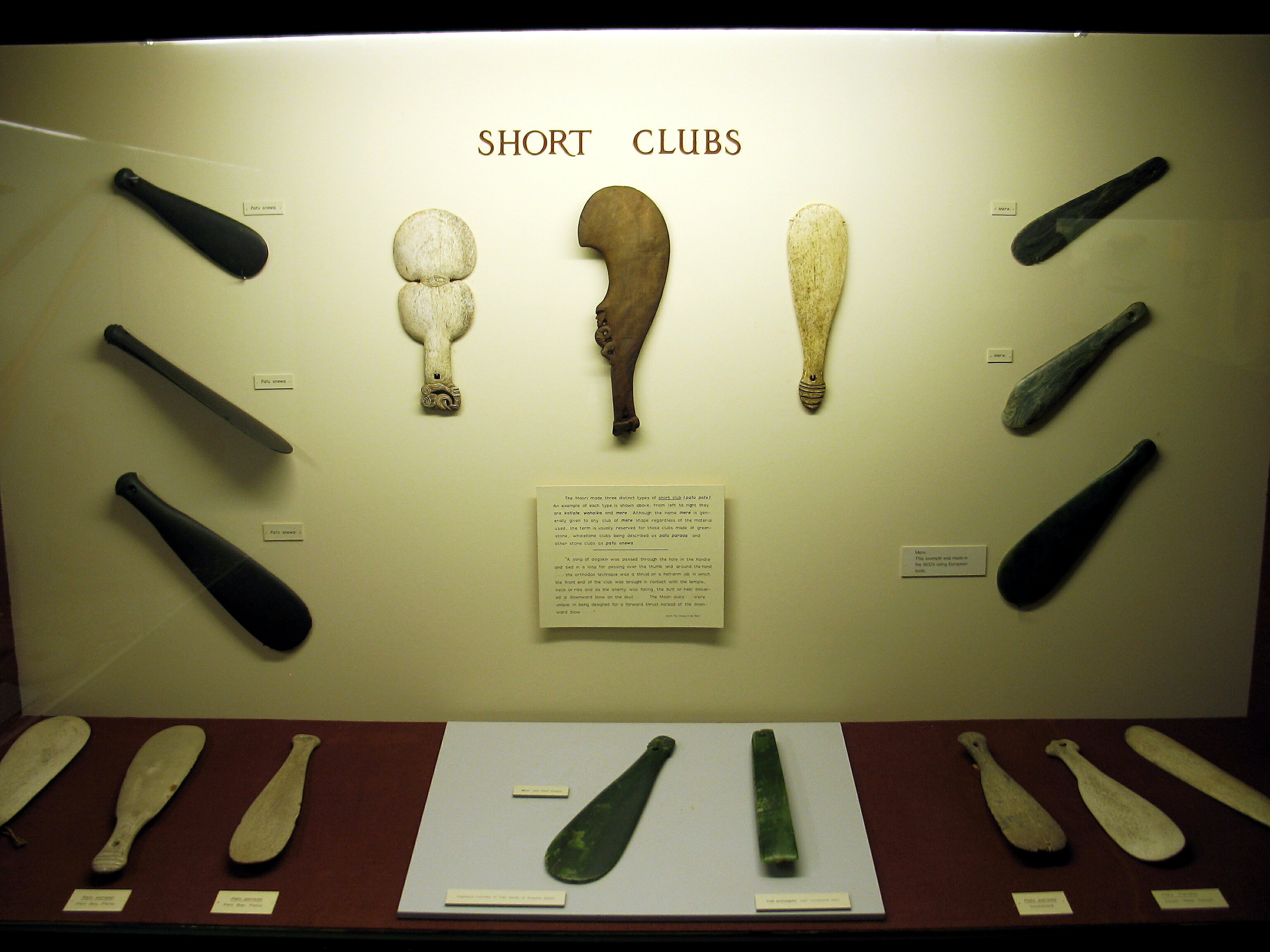
Let's get even more fanciful. The shape of this shoe horn also reminds me of the jade weapon called a mere, used by the Maori warriors of New Zealand in past centuries. Here's a sequence I shot in the Southland Museum at Invercargill.


And this was a modern replica I saw on sale in Auckland.


The mere was a serious close-combat weapon. The jade used for the best of them was very hard, and would easily break bones. It was used in a upward jabbing fashion, aimed at head, neck or ribs, and as the opponent fell, a sharp downward thrust on his head with the hilt would deliver the coup de grace. Warriors would of course have to face up to each other at very close quarters, and running away was considered so shameful as to be inconceivable. Personal and tribal honour depended on either killing one's opponent cleanly and skilfully, or accepting a killing blow if that opponent had the advantage. Yes, it has already struck me that a stiff shoe horn could be used in the same way, though hopefully not with lethal effect. But I dare say the police would take a dim view of using such an article in any way other than the normal one! 

Me, I can find other, less martial uses. For instance, here I am, recreating that Pop Idol moment. 


Pity I can't sing!

If you would like to give me feedback on this post, or make an enquiry, please email me from my Blog Profile.