Thursday, 19 September 2024

The kindness of strangers

In my experience, most people will help you out if asked nicely. 

For instance, yesterday I was in Oakham, the small town that is the 'capital' of Rutland, England's smallest traditional county. I'd parked Sophie, and was walking into the town centre, when I realised that I had still had my car keys dangling from my neck. Living alone, I have to resort to 'key management', meaning that all my essential keys for house and car are attached to a lanyard that I wear around my neck. Without fail - I'm never lazy about this - I put my keys around my neck whenever I step out of my front door, even just to pop something in the recycling bin at home. And I will naturally do this if going out for while. It's a good habit that has become ingrained. So long as I have my keys on a loop around my neck, I know that I can't accidentally lock myself out of house or car, with nobody to rescue me. But of course, while this expedient is fine for a short time, I don't want to 'wear' a bunch of keys all day. In that case, I take them off, and loop the lanyard around one of my handbag straps instead. Thus tethered, my keys can if I want be zipped up inside the bag - certainly if it's raining, but also if the environment makes it wise to keep house and car keys out of sight.

Well, there I was, in Oakham and already some distance from the car, with a couple of hours ahead of me, and wanting to transfer the lanyard from my neck to my bag. 

Could I do it? No. 

I should explain that there were four things around my neck: the cross-body strap of my bag; the cross-body strap of my camera; the lanyard from which my bunch of keys was dangling; and Starfishie's silver chain. Either in the car when driving along, or when I'd put the straps for bag and camera over my head once parked, Starfishie (my silver starfish from Orkney) had somehow wrapped her chain around the lanyard for my keys in some complicated way. The silver chain was now in a proper tangle, and felt as if it might be knotted. At any rate, I couldn't free it from the lanyard by touch alone. I needed a mirror. But here I was out on a pavement. It wasn't an emergency, of course, but it was something that needed sorting out without delay, for appearance's sake if nothing else; although it was also best not to make the knot in the silver chain worse than it was. If I walked on, it might gradually tighten up so much that I would never unravel it.

But good luck sent me a suitable helper. A lady appeared. She was maybe in her fifties - so far as you can ever tell - so somewhat younger than me. But I knew at a glance that she was likely to assist. You just know. So as she came closer, I said 'Excuse me, could you help me please? I'm in a bit of a tangle.' She stopped and smiled. 'Of course. Gosh, you're right. The chain's wrapped around the cord a couple of times, and seems to have got knotted. Let me see...' 

So there were were, standing together on a sunny pavement, practically head to head. I let her ease the chain free. It took a couple of minutes. She was clearly patient and methodical, and not the sort to give up. Nor did she. She persevered. Starfishie's chain was quite a fine one, and it would take good eyesight, care, and nimble fingers to sort this out. I hoped she hadn't been in some kind of hurry. But if she had been, she said nothing. Such is the overriding importance of one woman helping out another. I don't think that, in general. men ever show quite the same solidarity. 

Suddenly the chain was free. I thanked her warmly, and she went on her way. I suspected that I had indeed delayed her. On the other hand (I philosophised) we had both had a psychological boost. I'd set her a challenge, and she had met it with success. She'd also had the satisfaction of doing a good and useful deed, plus my sincere thanks. As for myself, I felt a glow from having a stranger's instant confidence and assistance, plus of course getting Starfishie's rather nice chain freed without damage. An encounter to remember. And now to write about.

Perhaps it's a trivial thing, perhaps not. We are often told that manners have coarsened and that in the modern world we have all become selfish. Certainly there are some awful people around, especially people whose aim in life is to fulfil a personal ambition that will entail stamping on others. It seems clear that those who become prominent in public life, or become household names, or are any kind of celebrity, eventually lose a sense of humility and a willingness to consider others not so admired. But most of us, in ordinary life, have not discarded the impulses to be helpful and full of good and decent intentions. It's good to know that the better side of human nature is alive and kicking and hasn't been abandoned. It's not naïve or foolish to be kind.

If you would like to give me feedback on this post, or make an enquiry, please email me from my Blog Profile.

Sunday, 1 September 2024

Shingle Street and a line of white shells

Back in May - already four months ago! - I was travelling in Suffolk and made a point of revisiting a favourite spot called Shingle Street. It's a collection of houses, with a Martello Tower at one end, and former coastguard cottages at the other, strung in a row behind a wide expanse shingle that overlooks a wide bay a few miles south of Orford. It's out of the way, down a wandering dead-end road, and you won't casually stumble upon it. You have to seek it out.

When I first discovered Shingle Street back in 1985, I was struck by its end-of-the-world atmosphere. Many of the houses were weather-beaten and ramshackle - although being mostly brick-built, they were somewhat more substantial than the miscellaneous collection of shacks you see at Dungeness in Kent. Many had proper gardens, albeit half-wild. The impression was of a community that came alive in the summer, when owners came to stay, but was very quiet in the winter. Despite the rust and peeling paint, it was all most attractive, even in February, when I came.

 On that first occasion I gave more photographic attention to the wide, sweeping bay and the three Martello Towers that I could see, whose guns once guarded this stretch of coastline. The cold restless sea constantly sucked at the shingle, making quite a noise. 


When I returned ten years later, in February 1995, I was rather more interested in the buildings and the scattered holiday paraphernalia of their part-time residents, which together evoked treasured memories of similar sunny places in Cornwall long ago; although of course those Cornish retreats looked out upon sand and rocks, not shingle. I was pleased to find that Shingle Street hadn't changed a bit in ten years. Even in the chill winds of February, it was easy to imagine what summer weekends there would be like - lazy days in a wicker chair with feet up, watching the clouds, or reading a book, with happy strolls now and then along the shingle beach. Simple contentment.

Here are some pictures from that 1995 visit, to show what was so appealing to me about the place:


Another ten years passed. I went back in 2005, this time in June, and noticed other things, such as the flowers growing on the shingle. 


This time there was some clear evidence that owners were giving their properties more attention. Shingle Street looked a little less ramshackle. Walls had been repainted. There were a few smart accents, like that red sunshade. 

I didn't let yet another ten years go by. I was back again as soon as October 2008. This time I blitzed the place, taking more photographs than hitherto. I wanted to capture its most appealing aspects, before it lost its charm.


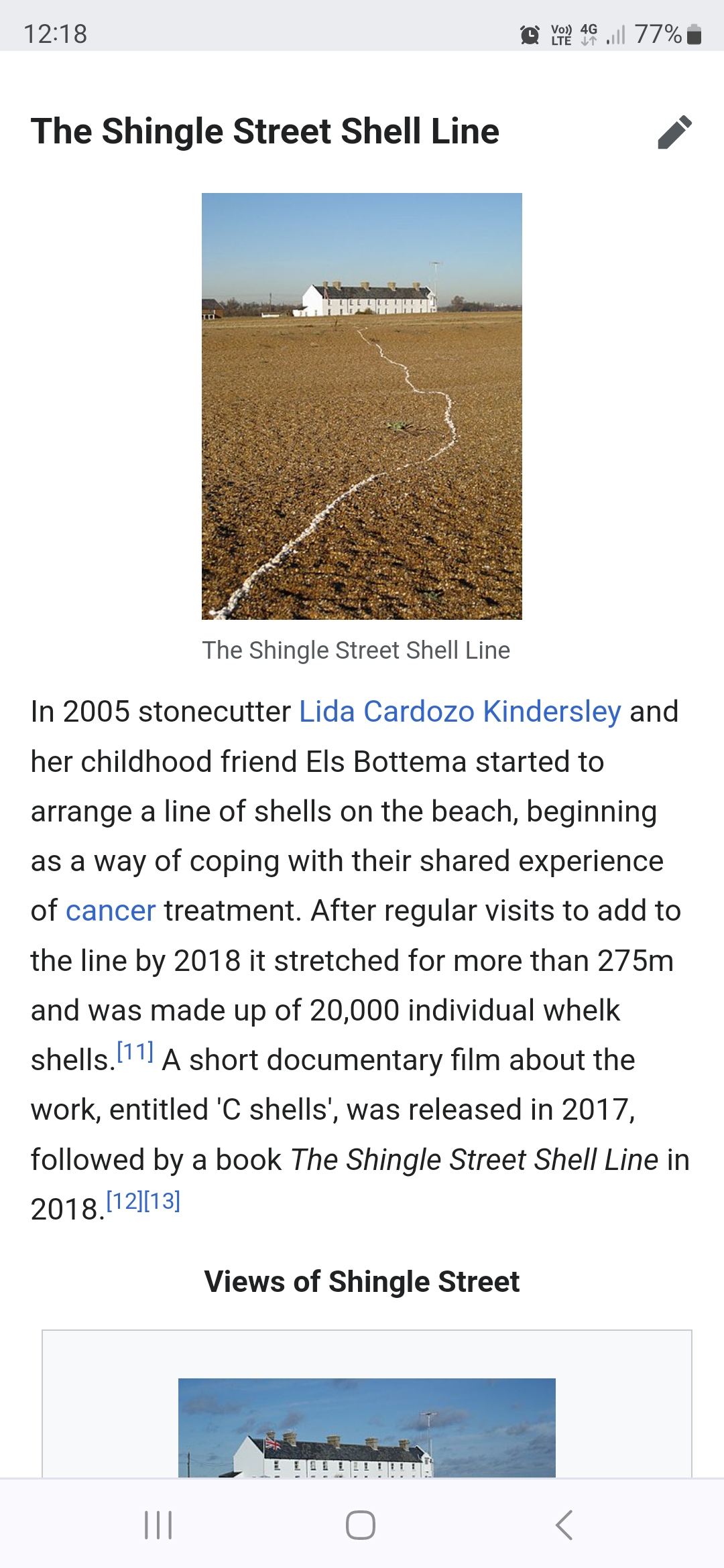
This time I came across something unusual. A long thin line of white shells that began (or ended) close to the high tide mark, and ran inland towards the coastguard cottages.


It was very well done. I was most impressed! And the thing was such a wonderful addition to the scene. But what a labour! What motive lay behind it?  There was nobody to ask. It occurred to me later than the person or persons who had created this line of shells were defying the malice and carelessness of vandals and others who might take pleasure in destroying this work of art (for that's what it was, surely). Well, good luck to the creators. But I didn't expect to see that line of shells on my next visit.

I was wrong. Years went by. When I revisited Shingle Street this year I found a line of white shells still there. 


It couldn't be the original line of shells - even if that had been respected by every visitor to Shingle Street through the years, and had escaped the heedless scuffing of young children and dogs, two or three stormy winters would have smudged or obliterated it. Therefore it had surely been refreshed at intervals, perhaps as a kind of ongoing tradition, and I imagined a family, down for a fortnight, spending the first couple of days tidying up that line of shells section by section. I wished I knew. (Research on the Internet has supplied the answer  - see the end of this post)

And what did the rest of Shingle Street look like after a sixteen-year absence?

For one thing, there was much more vegetation growing in the shingle. There were the expected seashore plants, but also colourful flowers, as if somebody had scattered a lot of seed packets, creating a colourful spectacle in places. But gorse was encroaching too. As for the buildings, they had had received even more attention, and generally speaking had been repainted and reroofed. In some cases, altered or even rebuilt. Here's a selection of my May 2024 shots (it was bright, but the sun wasn't out this time):


It's inevitable that owners upgrade their holiday homes. Tumbledown shacks give way to something smarter, with modern facilities and comforts. There was plenty of this now at Shingle Street, but its old charm hadn't been entirely lost. 

In 1972 I wrote a poem about a Cornish property called Corrib, which had a rear entrance off a sheltered and rather secret footpath that ran from the Trevose Golf Clubhouse down to the dunes at Constantine Bay, near Padstow. The opening lines went like this. (I was a sensitive soul in those days, fifty years ago)

A white gate in a tunnel of green:
That's Corrib, my Jamaican house.
A shady lawn, old tennis courts,
The bleached bones of a boat, or a seat,
Overgrown in a garden:
This is Corrib, my evening retreat.
 
There is a sandy path
That whispers through trees;
A tunnel of memories, a darkening arch.
Under boughs and down to the dunes
I flash by waving grass,
Rustling bushes and staring flowers.
Heedless of the evening breeze,
I hasten past broken gates and posts,
Forgotten by years and sagging in decline;
I look for the lights of Corrib,
My solace, dark refuge mine.

The Shingle Street I first knew had something of that atmosphere. I'm not sure it has any more. But it's still a magical place, a place apart anyway.

If you want to read the full poem, and to know more about Corrib and what happened to it, I wrote a post titled A tunnel of green, and a surfing bay on 15th October 2016, which you can easily look up.

Back to that intriguing line of white shells. I quickly found these web pages on the Internet - click on them to enlarge:


I'm even more impressed, in that it was originally a work started in convalescence, when the ladies concerned couldn't have been feeling too great. 

As for the long low building with a turret in the middle, near the coastguard cottages (and the landward end of the line of shells), I found this:


I don't know when I'll be in this part of Suffolk again. My priority for the future is to visit as much of the more distant parts of this country as possible, before the cost (or effort) of doing so by caravan becomes too much. So it must be Scotland, Northern England, and maybe Ireland, ahead of parts closer to my home in Sussex. 

If you would like to give me feedback on this post, or make an enquiry, please email me from my Blog Profile.

Saturday, 31 August 2024

A handsome man

I've just had what is - to me - a rather odd exchange of emails. 

Somebody had read my post Bugger Bognor, which I published on 31st December 2018. It's about Bognor Regis, the holiday resort on the West Sussex coast, and a visit I'd made to it. 

I took for the title of my post the famous words that King George V is supposed to have uttered in 1929, seven years before he died of bronchial distress in old age. He'd just had a lung operation, and probably wasn't in the mood to be complimentary about the town. You can imagine the scene. His doctors bobbing around, deferential yet firm. 'Your Majesty has come through the operation extremely well, but a month of fresh air on the south coast would be most beneficial.' The King would have rasped some tetchy reply. 'We think Bognor might be just the place.' At this, the King would have muttered 'Bugger Bognor', the prospect of a month of being wheeled along a windy promenade, and perhaps several therapeutic cold plunges in the sea, filling him with gloom. And who could blame him. 

In my post I described him as 'the severe-looking bearded gent who appeared on many of the older coins in my young life'. I also had in mind the photographs I'd seen of him in his later years, when to my eyes he looked like an impatient man with a short temper, with many cares, and not at all well.

Out of the blue I got an email from somebody who gave no name except the username they went by online. Being cautious, I might have ignored it for that reason alone, but the question they asked was reasonable enough: why had I described King George V as 'severe-looking'? The emailer thought he was 'a handsome man who looked good until the end'. 

Intrigued, I decided to reply. Emails are of course one-to-one, and in principle private. So to preserve confidentiality, I won't quote any more of the emailer's precise words, just the gist of what was put to me. But I will give my own responses in full. So I said this:

Whether a man is handsome or not depends on the onlooker's own standards. If you think he was handsome, then I won't challenge your personal opinion.  

To me, he is an historical  figure who died well before I was born, and I can only go by reports. Apparently he was a man who took his position as monarch very seriously, and expected the same seriousness from his family: certainly not a man to suffer frivolous or inappropriate behaviour. 

In particular he did not enjoy good health in later life, with chronic bronchial trouble, and I would expect the increasing discomfort and distress flowing from that to adversely affect his manner and his appearance. 

I therefore chose the word 'severe' to encapsulate in one word the demeanour of a man who carried more than just the burden of being the King.

As a PS to this, I asked why he or she didn't say who they really were:  

I use my real name. Why do you conceal yours behind an alias?

No matter who emails me, or what their email address is, they nearly always (if previously unknown to me) introduce themselves properly, and plainly state their interest. As you surely would if speaking face to face. This person answered by asserting that giving one's real name in an email didn't matter: it was optional. In fact he or she couldn't understand why I thought it so important. So I said:

All the same, you are still not being open with me: I don't know who you are, nor why a word I used in a blog post about a long-dead person should matter to you.

I took a risk in responding, but on a hunch that it was all right, I did, and apparently no harm has been done. But in general it's unwise to engage with anonymous (or effectively-anonymous) people, and I'm rather surprised that you disagree.

I thought that would be the end of it, but I got a final response. In it the emailer told me that she was aged twenty, gave me her proper name and one or two other details, then signed off. She hadn't expected me to reply to her original question. She also assumed that I'd never been on YouTube or TikTok, where nearly everyone people stuck to their special online names, didn't use their real name, and yet despite this, online communities got along fine without interrogating each other as to their true identity. 

I do feel that I irritated the emailer. Nevertheless, I remain convinced that full identity disclosure at the outset is the proper thing to do, and that hiding behind a pseudonym invites suspicion and mistrust - even if there are strong and good reasons for concealment, and even if it is entirely normal for the particular arena in which we are in contact. That said, I must be well out of step with current online practice, which nowadays seems to shun openness and transparency, and to favour complete anonymity; with everyone's exchanges - benign, vitriolic, conspiratorial, legal or utterly illegal - cloaked in encryption. The dangers and harms of this are obvious and endlessly discussed. Because of them I don't feel apologetic for wanting to know exactly who is writing to me.

One thing that has surprised me about this episode is that a girl of twenty discovered my blog and read one of my posts! I'd assumed that my readership was middle-aged or older, and that the subjects I cover would have no appeal or relevance for a younger person. It just shows how wrong you can be.

If you would like to give me feedback on this post, or make an enquiry, please email me from my Blog Profile.

Wednesday, 28 August 2024

Lord Justice James' Seat

This was a wooden bench with a fine view that I discovered in 1990. I sometimes sought it on my way home, as I needed a buffer between the office in London and whatever might await me at home near Horsham. These were the final months of my marriage: things were getting rather strained and distant. Parking the car, walking through quiet trees, and sitting for a while on Lord Justice James' Seat on Reynards Hill in Winterfold Forest, with its (then) glorious view to the south over Cranleigh, was a delight that I needed more and more. I might be reluctant to go home, but at least the place refreshed me and steadied me for whatever later arguments might begin. And of course, after we did split up, and I sat out a full five years waiting for a divorce, I went there again and again for some peaceful reflection. Late in the afternoon, I usually had it all to myself. 

Here are two shots of the Seat that I took in 1990. In this blue one, I was approaching from the car park; the person in the picture, by the Seat, had gone by the time I reached the spot. No doubt they needed solitude too. 


In 1990 the Seat was no more than a stout wooden bench, pretty old, held together by thick wire. Here's a close-up of it:


It does seem, from what was carved in the bench, as if the Seat had been installed in 1881. But since then it had suffered much decay. In this view fifteen years later, in 2005, that original Seat had been replaced by something more up-to-date, though it was still called Lord Justice James' Seat. 


As you can see, the Seat was set in a glade, open on its south side to the sun and the breeze. It was on a high spot, commanding a wide view. Off to the left, in the distance, you could make out planes taking off or landing at Gatwick Airport, although they were too far away to be heard. Off to the right, you could see a succession of hilly viewpoints that receded to the horizon. Wonderful, considering that this airy scene was actually in Surrey, and not very far from the edge of suburban London.


Hardly anything changed during the next five years. Here are equivalent views for 2010:


There was however decidedly more vegetation. Eventually the small trees and shrubs on those slopes grew large enough to obscure the view. I think this was a deliberate policy of the local conservators, to discourage mountain-bikers from using the slope as a downhill racetrack. But then those on foot, who wanted to see the famous view, complained. This was how things were in 2019:


There was something to see if you stood up, but it wasn't a perfect compromise. I missed how it had once been. The Seat itself had lately been replaced by a curvaceous recycled-plastic creation, bolted together, that looked as if it should last for decades to come.


It wasn't unattractive, and was clearly going to be resistant to both weather and wood-eating insects. But to my mind it lacked charm. Nor did it have any obvious link with the judge who had first admired the view. This work of eco-art was called 'Contour', and not 'Lord Justice James' Seat' any longer. But I should think the old name will the one to endure. I still sat on the new bench for a few minutes, just as I had on every previous occasion. Thankfully, it remained a good place to rest on. 

That 2019 visit revealed more than just a new bench. Not far off, in the woods, was an area strewn with movie-making equipment. It wasn't abandoned, but wasn't fastened down and could have been stolen pretty easily. 


I saw a car nearby that seemed to belong to a security man, but he was nowhere in sight. I wondered if he'd mind if I used the female side of those portable toilets. I tried the door. It was unlocked. I slid in, did my stuff - everything was working, as if still powered - and was not accosted as I moved away. 

What was all this about? Shortly afterwards the security man hoved into view. Equipment must have been scattered all over the place, and he had been doing his rounds. He told me that the producer and crew had been making a film about wartime commandos. That's all he knew. 

And for the next few years, I learned no more: I forgot about it. But then I returned a couple of days ago, wanting a good walk in Winterfold Forest, and at the end of it discovered something about how the vicinity had been used in wartime as a training-ground for spies, saboteurs and commandos. I found this information board at the car park - click on it to see it better:


So all was made clear: they'd been making a documentary about Winterfold, a country house used as a school for Special Forces personnel. 

As for the rest of my visit the other day, there's little to say. I wanted to get some exercise, armed with my stick and camera:  


And I got what I'd wanted: a good long forest walk, often over rough or steep ground, or where there were roots to trip me up. I certainly needed that stick! When I reached Lord Justice James' Seat, towards the end of my tramp, I was glad to sit down for five minutes. Surprisingly, my right knee wasn't protesting, although it had a right to do so; but it was warm and I was definitely puffed.


The spot looked much as it had in 2019, and the view was no better: a shame. 

I pondered the question of who Lord Justice James had been. Apparently a High Court Judge who lived in the nineteenth century. But deeper research on the Internet once home did not reveal his identity. True, the man who (in 1886) built the big country house down the hill called Winterfold - the wartime school for spies - had been a judge. He would have owned a swathe of local land, including where the Seat was. But he was Lord Chief Justice Viscount Alverstone (1842-1915), and before being elevated to the peerage he'd been Richard Everard Webster - not James. There appeared to be no other candidate. 

Perhaps it was really Viscount Alverstone's Seat after all, with the name somehow getting changed from Webster (or Alverstone) to James down the years. It would be nice to clear up this little mystery!

Sequel  Aha. I've now discovered that Sir William Milbourne James (1807-1881) was a judge. The year of his death, 1881, was carved on the original bench seat that appears in the first two shots above, taken in 1990. So the surname James, the date of 1881, and his being a judge are three things that suggest this might be the man. But I haven't yet found any connection between him and the Winterfold area. 

If you would like to give me feedback on this post, or make an enquiry, please email me from my Blog Profile.