Thursday, 31 October 2024

The man who befriended a circus freak

It's late September, and I'm in Wirksworth, a Derbyshire town south of Matlock, and I'm walking about with LXV, my Leica camera, shooting anything that catches my attention. 

This is typically what I do on holiday. I look for interesting things: often topical, often historical, sometimes quirky. I look for striking scenes, unusual light effects, and shoot both beauty and ugliness so long as it makes a good picture. Although it's a boast, I think I definitely have an eye for a shot. I don't try to be clever or arty; the aim is to capture aspects of a particular place or occasion. Later on I'll create a file in my archive for Wirksworth, and the day's photos, fully captioned, will go into it. And if I ever return, more photos will go in that file. In this way I gradually I build up an ongoing record of places, people and other subjects, spanning many years, so that I can (say) compare the pictures I took in 1990 with what I took in 2000, 2010 and 2020. It's fascinating to see the gradual changes. Including how advances in my equipment make for a better, more informative record. 

Right now I think the results from LXV, my Leica X Vario, are the best I've ever achieved, rivalled only by the Nikon D700 that I was using in 2008 (and the extraordinarily good f/2.8 24-70mm zoom lens I bought for it). But I can carry LXV all day long; the big full-frame Nikon was always too heavy for comfort, and impractical for social occasions. Weight and bulk do matter. Not that LXV is itself a featherweight - its fixed zoom lens contains a lot of fancy glass - but it's unobtrusive, unthreatening, quick to turn on and off, and very fast to use.  

So there I was, walking about Wirksworth. And a large old town house with big windows caught my eye. Then I saw a blue plaque. I had to look more closely.


Sir Frederick Treves. Aha! This was the man whose innovative surgical skill saved the life of King Edward VII, who developed appendicitis in 1902. But also, as the plaque says, he looked after Joseph Merrick, the Elephant Man. He was in practice here for a while when younger.

Poor Joseph Merrick. He died aged 27 of a broken neck, having attempted to sleep normally, lying down. He was grossly deformed. A chromosomal abnormality - which one is still debated - led to excessive and horrific bone growth, plus pendulous warty skin, all from an early age, so that by his teens he was dreadful to see. He had a lopsided appearance, with a huge misshapen head, a massive right arm and hand, and bent leg bones. The rest of him was normal. He was highly conscious of how ghastly he looked. In the 1880s it meant social revulsion and rejection, and invited the taunts of the brutal and the ignorant. 

The only opening for him, if he were to make his way in the world, was to put himself on exhibition under a manager for the paying public to gawp at, at first in a circus, then in a London shop, where Treves first saw him. Treves' first reaction was disgust. But nevertheless he asked Merrick to come to hospital, and for a while he became a clinical curiosity for the medical students to study. Objecting to this role, Merrick left, but ultimately returned to live at the hospital until his death. In that latter part of his life, with his deformities getting ever worse, a kind of friendship grew between he and Treves. 

Merrick had to sleep propped up, his oversized and very heavy head resting on his knee. Lying down (as ordinary people did) risked dislocating his neck, probably with lethal consequences. And so it was. I think he knowingly committed suicide that way, and who can blame him.

He first came to my attention when the 1980 film The Elephant Man was released. I was 28, but still as fearfully imaginative and impressionable as I had been at 8 or 18, and the image of Merrick in the film poster - a figure hidden beneath a black cloak and black hat, with a face mask - troubled me greatly. I was living in London at the time, and those posters were everywhere on the Underground. You couldn't get away from them. I had nightmares, imagining that I would actually encounter that cloaked figure. I shuddered at the thought that this ghoulish being would approach me, touch me, and the mask would be lifted to reveal the horror beneath. Or worse, a sudden full-on confrontation with no possible escape.

Since my early teens I'd known about the terrible things done to prisoners and internees in wartime concentration camps, but this was something else. It was highly disturbing. I felt threatened by it. I found it hard to sleep, thinking about it. I was trying to pass some important Inland Revenue exams at the time: the thought of the Elephant Man waiting for me around the next dark corner couldn't have helped. 

Writing this hasn't reawakened anything. So, forty-four years on, I must have put away a lot of fears. I suppose the shock-horrors of the cinema - grisly aliens, frightening robots, horrible infections - have inured me somewhat. But I still avoid horror films and anything that might prey on my mind like this had. 

I am still amazed at Treves' spectacular rise to eminence. He was born in ordinary circumstances in Dorset. He was working as a GP in Wirksworth, a Derbyshire practice far from London, in the 1870s. Ten years later he was established as a specialist abdominal surgeon in London. Perhaps it was a case of talent, famous patients, and (I doubt it not) good connections supercharging a career in nineteenth-century circumstances. 

Well, despite his fame, he kicked the bucket at 70. I've outlived him. Ha!

If you would like to give me feedback on this post, or make an enquiry, please email me from my Blog Profile.

Wednesday, 30 October 2024

Orkney gets nearer - I've booked the NorthLink ferry!

Hurrah! I've now booked the NorthLink ferry to Orkney and back! 

In fact I did it this morning, before the Budget. I'd just got an email from NorthLink to tell me that they had now published their 2025 ferry timetables, something I'd been waiting for, and that I could go ahead and book my car and caravan on whatever crossing I had in mind in May. I decided to act without delay, in case VAT was, after all, increased in the midday Budget. 

Making the booking online was a doddle until it came to payment. The website then stalled. I wondered whether, despite taking great care, I'd made some error. Perhaps a huge crowd of people were thinking along the same lines, hoping to get in before any Budget announcement on VAT. Or perhaps commercial operators with delivery lorries were swamping the website. Their bookings would come before mine, if sorted in pecking order. As I settled down by the radio to hear Rachel Reeves' Budget speech, the NorthLink website still hadn't confirmed payment taken, and my bookings successfully made. I let it go. Reviving the laptop after the Budget Speech, I discovered that the booking hadn't gone through, and NorthLink had cancelled it. 

I immediately rebooked. This time there was no problem. Hopefully the original payment authorised by my credit card company, which they had marked 'pending', will now just disappear or be matched by a refund, so that I'm not doubly out of pocket. However, at the time of writing this, my credit card account is showing two payments pending, one for the booking that didn't go through, and one for the booking that did. Gulp! It matters, because the return ferry charge is a whopping £277.48. So as things stand, I have paid twice that, £554.96. Fingers crossed that I get that refund promptly!

Still, this glitch hasn't spoiled my day. I feel elated at the thought that my week on Orkney next May is essentially in the bag. I had already booked the pitch at Stromness last August; now I've booked the ferry too. I still have a long series of Caravan Club site bookings to make, to get me up to Orkney and back from my home in Sussex, which will be quite a task, a whole morning on the laptop. But I've done this before, as far as Caithness anyway, most recently in 2022. I'm not daunted. But I'll need to make those site bookings before the end of this year, to secure the pitches I want at 2024 rates. 

This is an important holiday. It may be the last time I go so far north, some 800 miles by road from home. It will be my second visit to Orkney, and my fourth to Caithness. This time I intend to 'do' both of these far-away places so thoroughly, so definitively, that a further visit won't be justified. I'm not saying that I won't ever return, but facts have to faced: I'm no spring chicken, and although my eightieth birthday is still some years away, long-distance caravanning is already becoming a test of stamina. I might after this go no further north than Inverness and Aberdeenshire. Shetland still beckons: but I think that'll be a different kind of holiday. I'd have to fly there, stay in a hotel, and hire a car. Or if taking Sophie, leave the caravan at home, use the overnight ferry from Aberdeen, and rely mostly on Travelodges and Premier Inns instead. 

The pitch at Stromness is booked for 6th May to 12th May, departing 13th May. The ferries are therefore booked for the early afternoon of 6th May and late morning on 13th May. The rest of the holiday will be built around those dates. 

I've already sketched out the long chain of caravan site bookings that will take me there and back again. At the moment it looks like a 28th April departure from home, and a 4th June return. Basically I travel north as quickly as I can, spending the bulk of my time on Orkney and in Caithness, and then travel south at a more leisurely pace, allowing time to meet up with friends on the way. Even so, I probably won't be seeing anyone I know for a whole four weeks. It's a good thing that I never feel lonely! In fact, I'm a great one for chatting with complete strangers - something that usually happens at least once or twice a day when on holiday - and it seems the remoter the place, the more likely it is that some cheerful and warm-hearted person will be intrigued by who I am, and where I've come from.  

I have to admit that it will be an expensive holiday, so much so that I may have to put off buying a new laptop until late 2026, when the purchase payments on my car Sophie come to an end. Verity, my hard-working but still capable Microsoft Surface Book, will be ten years old by then. But putting off buying her replacement may work to my advantage: more time to assess what I should buy; more time for a powerful 2025 laptop to come down in price. 

Meanwhile, I will be prepping for my Orkney holiday in the months ahead. The time will soon pass!

If you would like to give me feedback on this post, or make an enquiry, please email me from my Blog Profile.

Monday, 14 October 2024

Money frauds

I am always struck by the stories that victims of money scams have to relate. I've heard lots of them over the years on radio programmes such as BBC Radio 4's You and Yours and Money Box, and elsewhere, such as on LBC. 

The victims of big-money scams seem to fall into three main groups. 

There are those who are phoned out of the blue and told by their bank - or rather someone who claims to be their bank - that their accounts have been hacked and that their balances need to be shifted pronto into another account where the money will be safe. They are hustled by the caller, given no time to think, and of course the money is whipped away into the hands of fraudsters who control the 'safe' account, and it's never seen again. It's usually a successful sting - however sensible, level-headed or forewarned the victim has hitherto believed themselves to be. The correct response (I would say) is to put the phone down, travel to the nearest bank branch, and enquire in person with genuine bank staff. But I'm sure many people can't react so coolly when presented with a dire situation. (I dare say I would - or at least could - fall victim too: the psychological compulsion to take a safe and simple way out from sudden catastrophe, overriding all caution, must be overwhelming) 

Then there are those looking for a better return on their spare cash, who see attractive advertisements when searching the Internet, or on social media, and are enticed into a fake or worthless investment scam that sucks more and more money from them. The scammers intend to strip them bare, and if possible draw others in. I suppose it's hard to resist an apparently golden opportunity to make big money from trendy-sounding assets. Of course you have to possess a lot of cash to be attracted in the first place. (That theoretically means I should never fall victim of investment scams! All my small savings are for eventual necessary spending - the next car, the next bout of dentistry, the next pair of glasses. I will never now have a nest-egg in the background that I might risk losing) 

Thirdly there are the victims of so-called romance fraud. This is the cruellest scam of all, the victim being led up the garden path in the name of love and companionship and eventually asked to lend money to the person who has achieved ascendency over them. Oddly but typically, scammer and victim never meet: it's another online thing where all is taken on trust. The grooming process may extend to several months before the sting happens; but by then the victim may be too well under the control of the scammer (and his team) to refuse cooperation. I have met women - it's most often women who fall victim - who told me they immediately became wary as soon as money was mentioned. I've heard about women who questioned the reason they were being asked to give money to the scammer, but were cleverly and convincingly reassured, and persuaded to cough up just like the most gullible victim would. It's like a magic spell, and it all ends the same. They are left broken-hearted, embarrassed, self-doubting, and seriously out of pocket. (As I love my freedom, and never intend to give it up for the sake of having anyone special in my life, I'd like to believe I would be quite immune to romance fraud. But the sensible side of me says 'Remain on your guard!', and I am listening)  

There are many other types of money scam, big and small. But these three are the main ones I've heard about.

Now there's one thing that links them all: the victim has some money. And I've often wondered how the scammers know who they are, if they are trying to target those people who have enough cash to make an elaborate sting worthwhile. Have they, for instance, subverted amenable bank employees to put the finger on a likely sucker? If they can do this, it would be a very efficient way to select victims. I'm thinking particularly of the first kind of fraud mentioned above, where they impersonate the bank to panic the victim into moving funds to an account that the fraudsters control. But surely it would be a wonderful advantage to have a well-off would-be investor, or a lonely heart with money to spare, handed to them on a plate? 

Or do they leave it to pure chance, relying on the victim selecting themselves, either from greed or silliness? Such as responding to a social media advertisement, or to some YouTube video about how to invest very cleverly, or a great profile on a dating app? Cupidity and gullibility must work a lot of the time, human nature being what it is. Who doesn't pay at least some attention to the promise of a better return, or to finding the perfect partner? 

I can certainly see why most banks have long resisted compensation codes (and now coming legislation) to restore cash taken from money fraud victims. They know how irrationally people will behave when pushed or lured, and compensation costs them dear. But they now also see that rapid no-quibble compensation is going to be the name of the game, up to an £85,000 maximum anyway. They'll be forced to tighten their procedures and checks, to limit the leakage of serious money to scammers. And that, of course, means yet more inconvenience and delay for the public, whenever any non-routine transaction occurs. As when buying a house or car. Each money transfer will have to be thoroughly checked out, more so than now. Let's hope that no important transaction fails because a bank took too much time to satisfy itself that all was genuine. 

If you would like to give me feedback on this post, or make an enquiry, please email me from my Blog Profile.

Friday, 11 October 2024

To pay or not to pay, that is the question

Sophie, my 2016 Volvo XC60 R-Design car - bought nearly a year ago from Caffyns Volvo Eastbourne - was a Volvo Selekt car, meaning that she was among the pick of vehicles traded-in for something newer, and was not only a good-looking, cared-for, low-mileage example, but was running particularly well and reliably, all settings correct and everything working properly. 

That made her a good bet if buying second-hand. However, it also meant a buyer would be paying more than the ordinary price for having such a car. I reckoned some £1,000 more. But I was in a hurry to buy a replacement for Fiona, my previous Volvo XC60, who was old and ailing, and I'd decided that if I could quickly find another XC60 with the right engine (that is, the biggest diesel option, suitable for hauling the caravan) I'd go for that. The price was secondary, although the financing had to be affordable. I was lucky. Caffyns had exactly what I wanted, and I secured Sophie as soon as I'd had the test drive.

Part of the Volvo Selekt package was a one-year used car warranty. I didn't give it a lot of thought at the time of buying, but after six months of ownership, I was glad that I had that warranty. A rear wheel sensor that monitored ABS and all sorts of related things packed in while I was away on holiday in April. Once home again, I had Caffyns look at it. The part was simple to replace, but its cost, and the technician's time to fit it, would come to about £300. Ah, I said, that might be covered by the one-year used car warranty! And so it was. It was all done while I waited, after Volvo HQ had authorised the work, and cost me not a penny. 

So for once I'd invoked a warranty and had had a satisfying outcome. The warranty hadn't been needed since. But the good experience last April had stayed in my mind. 

Now, in October, it was time to consider extending that warranty for another year. I was getting reminders from Volvo to do so. I had to act before 24th October.

Clearly it could be very useful. The warranty was basically for original factory-fitted parts that failed unexpectedly or prematurely for reasons other than customer misuse or ordinary wear and tear. The sensor that failed was a very good example. It was unlikely to break so early in the car's lifetime; and there was no way a customer could deliberately or carelessly induce failure. So no quibbling about covering its replacement. Mind you, the position for other parts might not be so clear-cut. And there were a lot of specific exclusions. 

So was it worth buying an extension to the warranty? After all, mine was a quality car made with tough components by a car company famous for its long-lasting products. Sophie had enjoyed a careful first owner, and was now being driven just as carefully by someone who tended to cherish her cars. Driver abuse could be ruled out. 

But chance mishaps and failures can happen. So it seemed to me that the answer was yes - that is, buy a warranty extension - if the cost were reasonable. Say £300 for another twelve months. But to pay no more than that. 

This decided, I responded to the reminders and filled in an online quotation form. Surprisingly, they asked me what Sophie's current value was. (Didn't they have data on that?) Sophie was first registered in April 2016, and her cash price then, when seven and a half years old, had been £19,500. Now she was a year older still. A quick glance at some same-age XC60s for sale on the Internet suggested that her current value might be £14,500. I put that in. 

The form completed, I asked for my quote.

£899.

What? £899 to extend the warranty for twelve months? It was far too much. Maybe a business executive, or a high-flying smart young professional on £90,000 a year, would pay that kind of money without hesitation, at least on a newer car, but it was beyond my income bracket. Yes, I did actually have the money in my savings account, but £899 would deplete those slender savings too much. 

If the money would cover the next three years, that would be different. But no, it was only for a year. 

Why so much? Well, I had of course already made a previous claim. That would bump up the premium a bit. And as Sophie aged, the likelihood of other qualifying component failures would increase. Yes, I could see why the cost might be high. And get higher. 

The latest service and MOT - just done - indicated all was good, with nothing likely to fail. So I might easily spend £899 for nothing - and then similar amounts year after year. Rather than feeling warm and happy from insuring myself against unexpected part failures, I'd in fact feel robbed and a little resentful. It made more sense to build up my savings account instead. Then if nothing went wrong, I'd still have the money. 

Episodes like this always make you feel you are exposing yourself to the whims of fate if you don't pay up. But nothing is ever entirely risk-free, whatever you do. I felt that Sophie had already proved herself to be a good reliable car, and not one of those unlucky cars that always need fixing. So it was rational to forego the umbrella of an extended warranty, and instead to accept a small amount of risk.

If you would like to give me feedback on this post, or make an enquiry, please email me from my Blog Profile.

Thursday, 19 September 2024

The kindness of strangers

In my experience, most people will help you out if asked nicely. 

For instance, yesterday I was in Oakham, the small town that is the 'capital' of Rutland, England's smallest traditional county. I'd parked Sophie, and was walking into the town centre, when I realised that I had still had my car keys dangling from my neck. Living alone, I have to resort to 'key management', meaning that all my essential keys for house and car are attached to a lanyard that I wear around my neck. Without fail - I'm never lazy about this - I put my keys around my neck whenever I step out of my front door, even just to pop something in the recycling bin at home. And I will naturally do this if going out for while. It's a good habit that has become ingrained. So long as I have my keys on a loop around my neck, I know that I can't accidentally lock myself out of house or car, with nobody to rescue me. But of course, while this expedient is fine for a short time, I don't want to 'wear' a bunch of keys all day. In that case, I take them off, and loop the lanyard around one of my handbag straps instead. Thus tethered, my keys can if I want be zipped up inside the bag - certainly if it's raining, but also if the environment makes it wise to keep house and car keys out of sight.

Well, there I was, in Oakham and already some distance from the car, with a couple of hours ahead of me, and wanting to transfer the lanyard from my neck to my bag. 

Could I do it? No. 

I should explain that there were four things around my neck: the cross-body strap of my bag; the cross-body strap of my camera; the lanyard from which my bunch of keys was dangling; and Starfishie's silver chain. Either in the car when driving along, or when I'd put the straps for bag and camera over my head once parked, Starfishie (my silver starfish from Orkney) had somehow wrapped her chain around the lanyard for my keys in some complicated way. The silver chain was now in a proper tangle, and felt as if it might be knotted. At any rate, I couldn't free it from the lanyard by touch alone. I needed a mirror. But here I was out on a pavement. It wasn't an emergency, of course, but it was something that needed sorting out without delay, for appearance's sake if nothing else; although it was also best not to make the knot in the silver chain worse than it was. If I walked on, it might gradually tighten up so much that I would never unravel it.

But good luck sent me a suitable helper. A lady appeared. She was maybe in her fifties - so far as you can ever tell - so somewhat younger than me. But I knew at a glance that she was likely to assist. You just know. So as she came closer, I said 'Excuse me, could you help me please? I'm in a bit of a tangle.' She stopped and smiled. 'Of course. Gosh, you're right. The chain's wrapped around the cord a couple of times, and seems to have got knotted. Let me see...' 

So there were were, standing together on a sunny pavement, practically head to head. I let her ease the chain free. It took a couple of minutes. She was clearly patient and methodical, and not the sort to give up. Nor did she. She persevered. Starfishie's chain was quite a fine one, and it would take good eyesight, care, and nimble fingers to sort this out. I hoped she hadn't been in some kind of hurry. But if she had been, she said nothing. Such is the overriding importance of one woman helping out another. I don't think that, in general. men ever show quite the same solidarity. 

Suddenly the chain was free. I thanked her warmly, and she went on her way. I suspected that I had indeed delayed her. On the other hand (I philosophised) we had both had a psychological boost. I'd set her a challenge, and she had met it with success. She'd also had the satisfaction of doing a good and useful deed, plus my sincere thanks. As for myself, I felt a glow from having a stranger's instant confidence and assistance, plus of course getting Starfishie's rather nice chain freed without damage. An encounter to remember. And now to write about.

Perhaps it's a trivial thing, perhaps not. We are often told that manners have coarsened and that in the modern world we have all become selfish. Certainly there are some awful people around, especially people whose aim in life is to fulfil a personal ambition that will entail stamping on others. It seems clear that those who become prominent in public life, or become household names, or are any kind of celebrity, eventually lose a sense of humility and a willingness to consider others not so admired. But most of us, in ordinary life, have not discarded the impulses to be helpful and full of good and decent intentions. It's good to know that the better side of human nature is alive and kicking and hasn't been abandoned. It's not naïve or foolish to be kind.

If you would like to give me feedback on this post, or make an enquiry, please email me from my Blog Profile.

Sunday, 1 September 2024

Shingle Street and a line of white shells

Back in May - already four months ago! - I was travelling in Suffolk and made a point of revisiting a favourite spot called Shingle Street. It's a collection of houses, with a Martello Tower at one end, and former coastguard cottages at the other, strung in a row behind a wide expanse shingle that overlooks a wide bay a few miles south of Orford. It's out of the way, down a wandering dead-end road, and you won't casually stumble upon it. You have to seek it out.

When I first discovered Shingle Street back in 1985, I was struck by its end-of-the-world atmosphere. Many of the houses were weather-beaten and ramshackle - although being mostly brick-built, they were somewhat more substantial than the miscellaneous collection of shacks you see at Dungeness in Kent. Many had proper gardens, albeit half-wild. The impression was of a community that came alive in the summer, when owners came to stay, but was very quiet in the winter. Despite the rust and peeling paint, it was all most attractive, even in February, when I came.

 On that first occasion I gave more photographic attention to the wide, sweeping bay and the three Martello Towers that I could see, whose guns once guarded this stretch of coastline. The cold restless sea constantly sucked at the shingle, making quite a noise. 


When I returned ten years later, in February 1995, I was rather more interested in the buildings and the scattered holiday paraphernalia of their part-time residents, which together evoked treasured memories of similar sunny places in Cornwall long ago; although of course those Cornish retreats looked out upon sand and rocks, not shingle. I was pleased to find that Shingle Street hadn't changed a bit in ten years. Even in the chill winds of February, it was easy to imagine what summer weekends there would be like - lazy days in a wicker chair with feet up, watching the clouds, or reading a book, with happy strolls now and then along the shingle beach. Simple contentment.

Here are some pictures from that 1995 visit, to show what was so appealing to me about the place:


Another ten years passed. I went back in 2005, this time in June, and noticed other things, such as the flowers growing on the shingle. 


This time there was some clear evidence that owners were giving their properties more attention. Shingle Street looked a little less ramshackle. Walls had been repainted. There were a few smart accents, like that red sunshade. 

I didn't let yet another ten years go by. I was back again as soon as October 2008. This time I blitzed the place, taking more photographs than hitherto. I wanted to capture its most appealing aspects, before it lost its charm.


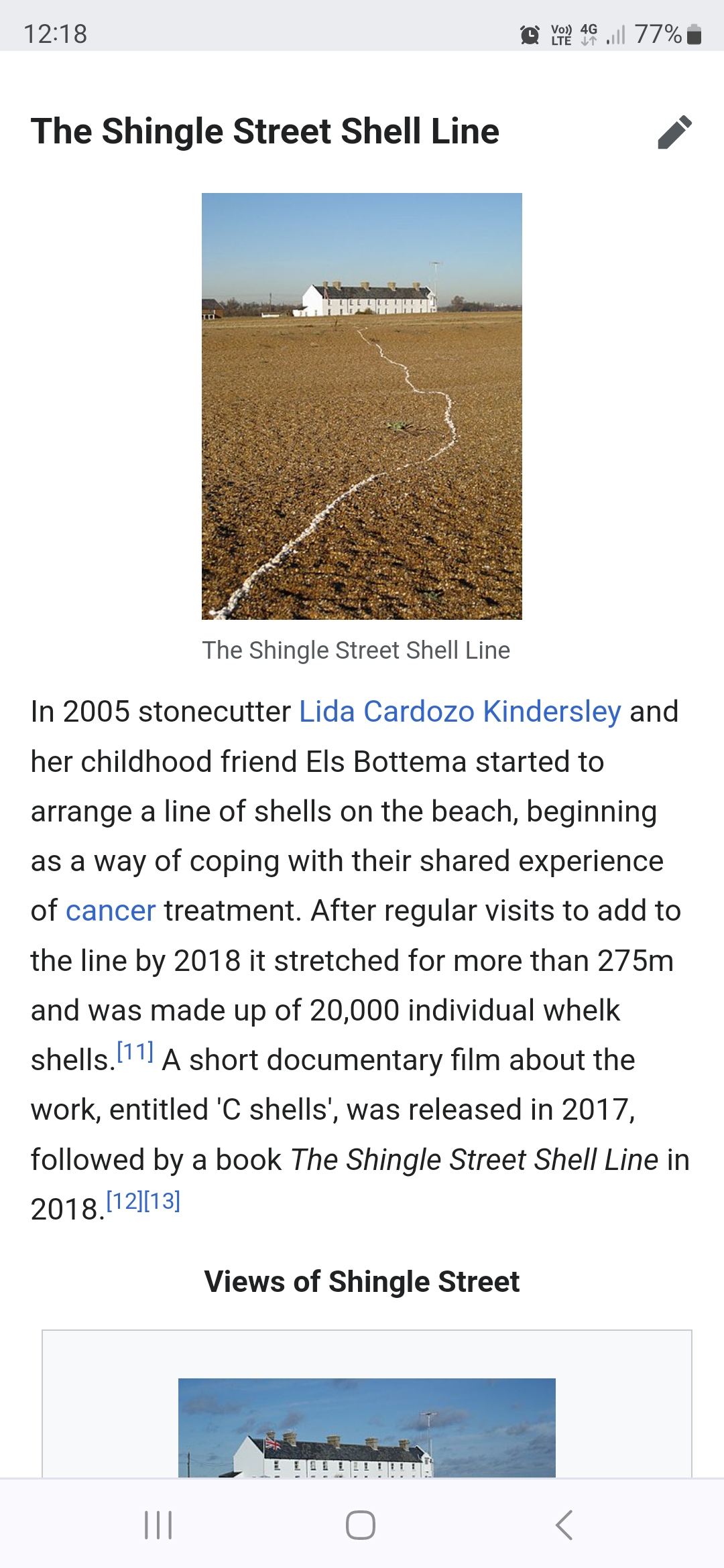
This time I came across something unusual. A long thin line of white shells that began (or ended) close to the high tide mark, and ran inland towards the coastguard cottages.


It was very well done. I was most impressed! And the thing was such a wonderful addition to the scene. But what a labour! What motive lay behind it?  There was nobody to ask. It occurred to me later than the person or persons who had created this line of shells were defying the malice and carelessness of vandals and others who might take pleasure in destroying this work of art (for that's what it was, surely). Well, good luck to the creators. But I didn't expect to see that line of shells on my next visit.

I was wrong. Years went by. When I revisited Shingle Street this year I found a line of white shells still there. 


It couldn't be the original line of shells - even if that had been respected by every visitor to Shingle Street through the years, and had escaped the heedless scuffing of young children and dogs, two or three stormy winters would have smudged or obliterated it. Therefore it had surely been refreshed at intervals, perhaps as a kind of ongoing tradition, and I imagined a family, down for a fortnight, spending the first couple of days tidying up that line of shells section by section. I wished I knew. (Research on the Internet has supplied the answer  - see the end of this post)

And what did the rest of Shingle Street look like after a sixteen-year absence?

For one thing, there was much more vegetation growing in the shingle. There were the expected seashore plants, but also colourful flowers, as if somebody had scattered a lot of seed packets, creating a colourful spectacle in places. But gorse was encroaching too. As for the buildings, they had had received even more attention, and generally speaking had been repainted and reroofed. In some cases, altered or even rebuilt. Here's a selection of my May 2024 shots (it was bright, but the sun wasn't out this time):


It's inevitable that owners upgrade their holiday homes. Tumbledown shacks give way to something smarter, with modern facilities and comforts. There was plenty of this now at Shingle Street, but its old charm hadn't been entirely lost. 

In 1972 I wrote a poem about a Cornish property called Corrib, which had a rear entrance off a sheltered and rather secret footpath that ran from the Trevose Golf Clubhouse down to the dunes at Constantine Bay, near Padstow. The opening lines went like this. (I was a sensitive soul in those days, fifty years ago)

A white gate in a tunnel of green:
That's Corrib, my Jamaican house.
A shady lawn, old tennis courts,
The bleached bones of a boat, or a seat,
Overgrown in a garden:
This is Corrib, my evening retreat.
 
There is a sandy path
That whispers through trees;
A tunnel of memories, a darkening arch.
Under boughs and down to the dunes
I flash by waving grass,
Rustling bushes and staring flowers.
Heedless of the evening breeze,
I hasten past broken gates and posts,
Forgotten by years and sagging in decline;
I look for the lights of Corrib,
My solace, dark refuge mine.

The Shingle Street I first knew had something of that atmosphere. I'm not sure it has any more. But it's still a magical place, a place apart anyway.

If you want to read the full poem, and to know more about Corrib and what happened to it, I wrote a post titled A tunnel of green, and a surfing bay on 15th October 2016, which you can easily look up.

Back to that intriguing line of white shells. I quickly found these web pages on the Internet - click on them to enlarge:


I'm even more impressed, in that it was originally a work started in convalescence, when the ladies concerned couldn't have been feeling too great. 

As for the long low building with a turret in the middle, near the coastguard cottages (and the landward end of the line of shells), I found this:


I don't know when I'll be in this part of Suffolk again. My priority for the future is to visit as much of the more distant parts of this country as possible, before the cost (or effort) of doing so by caravan becomes too much. So it must be Scotland, Northern England, and maybe Ireland, ahead of parts closer to my home in Sussex. 

If you would like to give me feedback on this post, or make an enquiry, please email me from my Blog Profile.