Sunday, 1 September 2024

Shingle Street and a line of white shells

Back in May - already four months ago! - I was travelling in Suffolk and made a point of revisiting a favourite spot called Shingle Street. It's a collection of houses, with a Martello Tower at one end, and former coastguard cottages at the other, strung in a row behind a wide expanse shingle that overlooks a wide bay a few miles south of Orford. It's out of the way, down a wandering dead-end road, and you won't casually stumble upon it. You have to seek it out.

When I first discovered Shingle Street back in 1985, I was struck by its end-of-the-world atmosphere. Many of the houses were weather-beaten and ramshackle - although being mostly brick-built, they were somewhat more substantial than the miscellaneous collection of shacks you see at Dungeness in Kent. Many had proper gardens, albeit half-wild. The impression was of a community that came alive in the summer, when owners came to stay, but was very quiet in the winter. Despite the rust and peeling paint, it was all most attractive, even in February, when I came.

 On that first occasion I gave more photographic attention to the wide, sweeping bay and the three Martello Towers that I could see, whose guns once guarded this stretch of coastline. The cold restless sea constantly sucked at the shingle, making quite a noise. 


When I returned ten years later, in February 1995, I was rather more interested in the buildings and the scattered holiday paraphernalia of their part-time residents, which together evoked treasured memories of similar sunny places in Cornwall long ago; although of course those Cornish retreats looked out upon sand and rocks, not shingle. I was pleased to find that Shingle Street hadn't changed a bit in ten years. Even in the chill winds of February, it was easy to imagine what summer weekends there would be like - lazy days in a wicker chair with feet up, watching the clouds, or reading a book, with happy strolls now and then along the shingle beach. Simple contentment.

Here are some pictures from that 1995 visit, to show what was so appealing to me about the place:


Another ten years passed. I went back in 2005, this time in June, and noticed other things, such as the flowers growing on the shingle. 


This time there was some clear evidence that owners were giving their properties more attention. Shingle Street looked a little less ramshackle. Walls had been repainted. There were a few smart accents, like that red sunshade. 

I didn't let yet another ten years go by. I was back again as soon as October 2008. This time I blitzed the place, taking more photographs than hitherto. I wanted to capture its most appealing aspects, before it lost its charm.


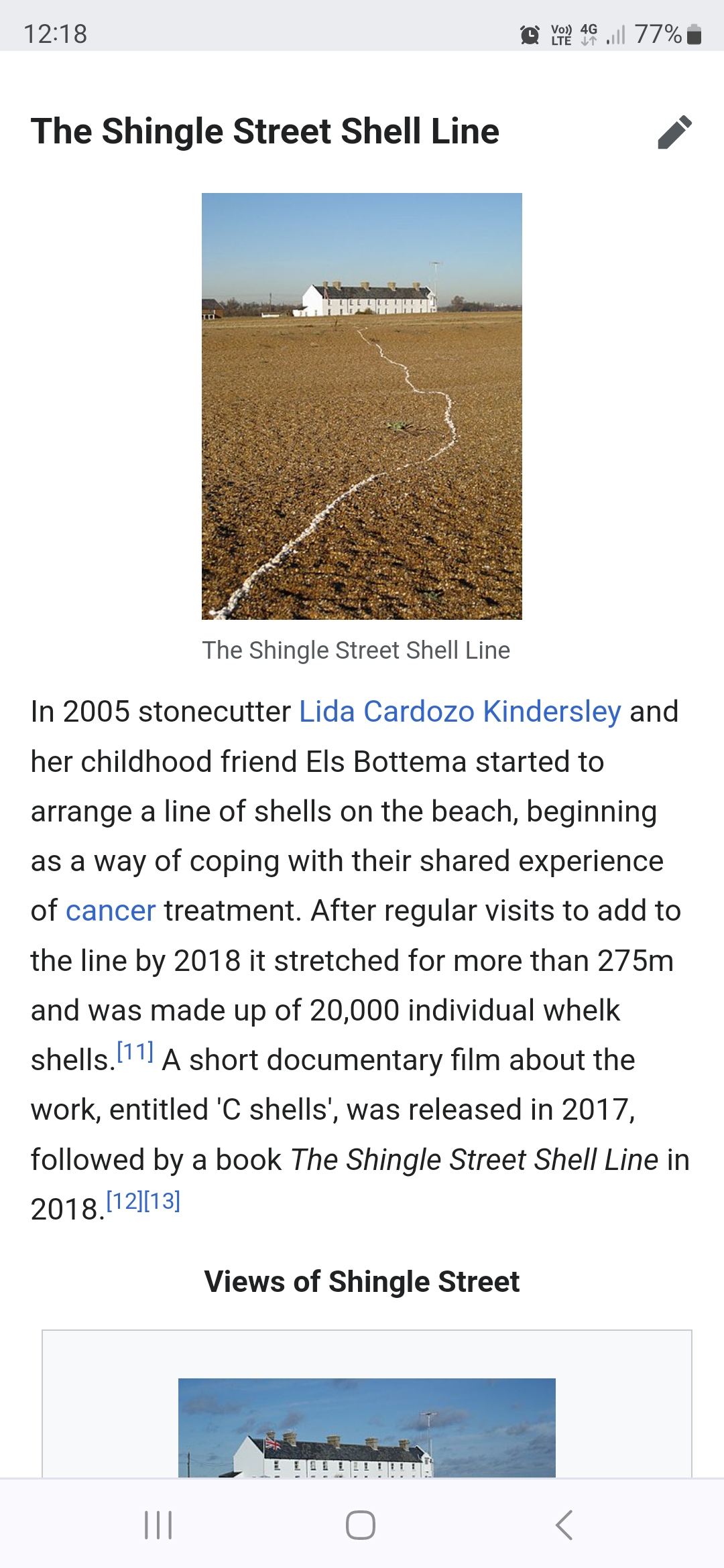
This time I came across something unusual. A long thin line of white shells that began (or ended) close to the high tide mark, and ran inland towards the coastguard cottages.


It was very well done. I was most impressed! And the thing was such a wonderful addition to the scene. But what a labour! What motive lay behind it?  There was nobody to ask. It occurred to me later than the person or persons who had created this line of shells were defying the malice and carelessness of vandals and others who might take pleasure in destroying this work of art (for that's what it was, surely). Well, good luck to the creators. But I didn't expect to see that line of shells on my next visit.

I was wrong. Years went by. When I revisited Shingle Street this year I found a line of white shells still there. 


It couldn't be the original line of shells - even if that had been respected by every visitor to Shingle Street through the years, and had escaped the heedless scuffing of young children and dogs, two or three stormy winters would have smudged or obliterated it. Therefore it had surely been refreshed at intervals, perhaps as a kind of ongoing tradition, and I imagined a family, down for a fortnight, spending the first couple of days tidying up that line of shells section by section. I wished I knew. (Research on the Internet has supplied the answer  - see the end of this post)

And what did the rest of Shingle Street look like after a sixteen-year absence?

For one thing, there was much more vegetation growing in the shingle. There were the expected seashore plants, but also colourful flowers, as if somebody had scattered a lot of seed packets, creating a colourful spectacle in places. But gorse was encroaching too. As for the buildings, they had had received even more attention, and generally speaking had been repainted and reroofed. In some cases, altered or even rebuilt. Here's a selection of my May 2024 shots (it was bright, but the sun wasn't out this time):


It's inevitable that owners upgrade their holiday homes. Tumbledown shacks give way to something smarter, with modern facilities and comforts. There was plenty of this now at Shingle Street, but its old charm hadn't been entirely lost. 

In 1972 I wrote a poem about a Cornish property called Corrib, which had a rear entrance off a sheltered and rather secret footpath that ran from the Trevose Golf Clubhouse down to the dunes at Constantine Bay, near Padstow. The opening lines went like this. (I was a sensitive soul in those days, fifty years ago)

A white gate in a tunnel of green:
That's Corrib, my Jamaican house.
A shady lawn, old tennis courts,
The bleached bones of a boat, or a seat,
Overgrown in a garden:
This is Corrib, my evening retreat.
 
There is a sandy path
That whispers through trees;
A tunnel of memories, a darkening arch.
Under boughs and down to the dunes
I flash by waving grass,
Rustling bushes and staring flowers.
Heedless of the evening breeze,
I hasten past broken gates and posts,
Forgotten by years and sagging in decline;
I look for the lights of Corrib,
My solace, dark refuge mine.

The Shingle Street I first knew had something of that atmosphere. I'm not sure it has any more. But it's still a magical place, a place apart anyway.

If you want to read the full poem, and to know more about Corrib and what happened to it, I wrote a post titled A tunnel of green, and a surfing bay on 15th October 2016, which you can easily look up.

Back to that intriguing line of white shells. I quickly found these web pages on the Internet - click on them to enlarge:


I'm even more impressed, in that it was originally a work started in convalescence, when the ladies concerned couldn't have been feeling too great. 

As for the long low building with a turret in the middle, near the coastguard cottages (and the landward end of the line of shells), I found this:


I don't know when I'll be in this part of Suffolk again. My priority for the future is to visit as much of the more distant parts of this country as possible, before the cost (or effort) of doing so by caravan becomes too much. So it must be Scotland, Northern England, and maybe Ireland, ahead of parts closer to my home in Sussex. 

If you would like to give me feedback on this post, or make an enquiry, please email me from my Blog Profile.

Saturday, 31 August 2024

A handsome man

I've just had what is - to me - a rather odd exchange of emails. 

Somebody had read my post Bugger Bognor, which I published on 31st December 2018. It's about Bognor Regis, the holiday resort on the West Sussex coast, and a visit I'd made to it. 

I took for the title of my post the famous words that King George V is supposed to have uttered in 1929, seven years before he died of bronchial distress in old age. He'd just had a lung operation, and probably wasn't in the mood to be complimentary about the town. You can imagine the scene. His doctors bobbing around, deferential yet firm. 'Your Majesty has come through the operation extremely well, but a month of fresh air on the south coast would be most beneficial.' The King would have rasped some tetchy reply. 'We think Bognor might be just the place.' At this, the King would have muttered 'Bugger Bognor', the prospect of a month of being wheeled along a windy promenade, and perhaps several therapeutic cold plunges in the sea, filling him with gloom. And who could blame him. 

In my post I described him as 'the severe-looking bearded gent who appeared on many of the older coins in my young life'. I also had in mind the photographs I'd seen of him in his later years, when to my eyes he looked like an impatient man with a short temper, with many cares, and not at all well.

Out of the blue I got an email from somebody who gave no name except the username they went by online. Being cautious, I might have ignored it for that reason alone, but the question they asked was reasonable enough: why had I described King George V as 'severe-looking'? The emailer thought he was 'a handsome man who looked good until the end'. 

Intrigued, I decided to reply. Emails are of course one-to-one, and in principle private. So to preserve confidentiality, I won't quote any more of the emailer's precise words, just the gist of what was put to me. But I will give my own responses in full. So I said this:

Whether a man is handsome or not depends on the onlooker's own standards. If you think he was handsome, then I won't challenge your personal opinion.  

To me, he is an historical  figure who died well before I was born, and I can only go by reports. Apparently he was a man who took his position as monarch very seriously, and expected the same seriousness from his family: certainly not a man to suffer frivolous or inappropriate behaviour. 

In particular he did not enjoy good health in later life, with chronic bronchial trouble, and I would expect the increasing discomfort and distress flowing from that to adversely affect his manner and his appearance. 

I therefore chose the word 'severe' to encapsulate in one word the demeanour of a man who carried more than just the burden of being the King.

As a PS to this, I asked why he or she didn't say who they really were:  

I use my real name. Why do you conceal yours behind an alias?

No matter who emails me, or what their email address is, they nearly always (if previously unknown to me) introduce themselves properly, and plainly state their interest. As you surely would if speaking face to face. This person answered by asserting that giving one's real name in an email didn't matter: it was optional. In fact he or she couldn't understand why I thought it so important. So I said:

All the same, you are still not being open with me: I don't know who you are, nor why a word I used in a blog post about a long-dead person should matter to you.

I took a risk in responding, but on a hunch that it was all right, I did, and apparently no harm has been done. But in general it's unwise to engage with anonymous (or effectively-anonymous) people, and I'm rather surprised that you disagree.

I thought that would be the end of it, but I got a final response. In it the emailer told me that she was aged twenty, gave me her proper name and one or two other details, then signed off. She hadn't expected me to reply to her original question. She also assumed that I'd never been on YouTube or TikTok, where nearly everyone people stuck to their special online names, didn't use their real name, and yet despite this, online communities got along fine without interrogating each other as to their true identity. 

I do feel that I irritated the emailer. Nevertheless, I remain convinced that full identity disclosure at the outset is the proper thing to do, and that hiding behind a pseudonym invites suspicion and mistrust - even if there are strong and good reasons for concealment, and even if it is entirely normal for the particular arena in which we are in contact. That said, I must be well out of step with current online practice, which nowadays seems to shun openness and transparency, and to favour complete anonymity; with everyone's exchanges - benign, vitriolic, conspiratorial, legal or utterly illegal - cloaked in encryption. The dangers and harms of this are obvious and endlessly discussed. Because of them I don't feel apologetic for wanting to know exactly who is writing to me.

One thing that has surprised me about this episode is that a girl of twenty discovered my blog and read one of my posts! I'd assumed that my readership was middle-aged or older, and that the subjects I cover would have no appeal or relevance for a younger person. It just shows how wrong you can be.

If you would like to give me feedback on this post, or make an enquiry, please email me from my Blog Profile.

Wednesday, 28 August 2024

Lord Justice James' Seat

This was a wooden bench with a fine view that I discovered in 1990. I sometimes sought it on my way home, as I needed a buffer between the office in London and whatever might await me at home near Horsham. These were the final months of my marriage: things were getting rather strained and distant. Parking the car, walking through quiet trees, and sitting for a while on Lord Justice James' Seat on Reynards Hill in Winterfold Forest, with its (then) glorious view to the south over Cranleigh, was a delight that I needed more and more. I might be reluctant to go home, but at least the place refreshed me and steadied me for whatever later arguments might begin. And of course, after we did split up, and I sat out a full five years waiting for a divorce, I went there again and again for some peaceful reflection. Late in the afternoon, I usually had it all to myself. 

Here are two shots of the Seat that I took in 1990. In this blue one, I was approaching from the car park; the person in the picture, by the Seat, had gone by the time I reached the spot. No doubt they needed solitude too. 


In 1990 the Seat was no more than a stout wooden bench, pretty old, held together by thick wire. Here's a close-up of it:


It does seem, from what was carved in the bench, as if the Seat had been installed in 1881. But since then it had suffered much decay. In this view fifteen years later, in 2005, that original Seat had been replaced by something more up-to-date, though it was still called Lord Justice James' Seat. 


As you can see, the Seat was set in a glade, open on its south side to the sun and the breeze. It was on a high spot, commanding a wide view. Off to the left, in the distance, you could make out planes taking off or landing at Gatwick Airport, although they were too far away to be heard. Off to the right, you could see a succession of hilly viewpoints that receded to the horizon. Wonderful, considering that this airy scene was actually in Surrey, and not very far from the edge of suburban London.


Hardly anything changed during the next five years. Here are equivalent views for 2010:


There was however decidedly more vegetation. Eventually the small trees and shrubs on those slopes grew large enough to obscure the view. I think this was a deliberate policy of the local conservators, to discourage mountain-bikers from using the slope as a downhill racetrack. But then those on foot, who wanted to see the famous view, complained. This was how things were in 2019:


There was something to see if you stood up, but it wasn't a perfect compromise. I missed how it had once been. The Seat itself had lately been replaced by a curvaceous recycled-plastic creation, bolted together, that looked as if it should last for decades to come.


It wasn't unattractive, and was clearly going to be resistant to both weather and wood-eating insects. But to my mind it lacked charm. Nor did it have any obvious link with the judge who had first admired the view. This work of eco-art was called 'Contour', and not 'Lord Justice James' Seat' any longer. But I should think the old name will the one to endure. I still sat on the new bench for a few minutes, just as I had on every previous occasion. Thankfully, it remained a good place to rest on. 

That 2019 visit revealed more than just a new bench. Not far off, in the woods, was an area strewn with movie-making equipment. It wasn't abandoned, but wasn't fastened down and could have been stolen pretty easily. 


I saw a car nearby that seemed to belong to a security man, but he was nowhere in sight. I wondered if he'd mind if I used the female side of those portable toilets. I tried the door. It was unlocked. I slid in, did my stuff - everything was working, as if still powered - and was not accosted as I moved away. 

What was all this about? Shortly afterwards the security man hoved into view. Equipment must have been scattered all over the place, and he had been doing his rounds. He told me that the producer and crew had been making a film about wartime commandos. That's all he knew. 

And for the next few years, I learned no more: I forgot about it. But then I returned a couple of days ago, wanting a good walk in Winterfold Forest, and at the end of it discovered something about how the vicinity had been used in wartime as a training-ground for spies, saboteurs and commandos. I found this information board at the car park - click on it to see it better:


So all was made clear: they'd been making a documentary about Winterfold, a country house used as a school for Special Forces personnel. 

As for the rest of my visit the other day, there's little to say. I wanted to get some exercise, armed with my stick and camera:  


And I got what I'd wanted: a good long forest walk, often over rough or steep ground, or where there were roots to trip me up. I certainly needed that stick! When I reached Lord Justice James' Seat, towards the end of my tramp, I was glad to sit down for five minutes. Surprisingly, my right knee wasn't protesting, although it had a right to do so; but it was warm and I was definitely puffed.


The spot looked much as it had in 2019, and the view was no better: a shame. 

I pondered the question of who Lord Justice James had been. Apparently a High Court Judge who lived in the nineteenth century. But deeper research on the Internet once home did not reveal his identity. True, the man who (in 1886) built the big country house down the hill called Winterfold - the wartime school for spies - had been a judge. He would have owned a swathe of local land, including where the Seat was. But he was Lord Chief Justice Viscount Alverstone (1842-1915), and before being elevated to the peerage he'd been Richard Everard Webster - not James. There appeared to be no other candidate. 

Perhaps it was really Viscount Alverstone's Seat after all, with the name somehow getting changed from Webster (or Alverstone) to James down the years. It would be nice to clear up this little mystery!

Sequel  Aha. I've now discovered that Sir William Milbourne James (1807-1881) was a judge. The year of his death, 1881, was carved on the original bench seat that appears in the first two shots above, taken in 1990. So the surname James, the date of 1881, and his being a judge are three things that suggest this might be the man. But I haven't yet found any connection between him and the Winterfold area. 

If you would like to give me feedback on this post, or make an enquiry, please email me from my Blog Profile.

Under contract again

From May 2021 I had a SIM-only mobile phone contract going with EE - for 160GB of data, at their best speeds. It expired two years later, in May 2023. The service had simply run on. I paid for it, and got what I paid for, but EE had no enforceable duty towards me as I was out of contract. 

The May 2021 contract had begun at £20 per month, but had gradually become more expensive as annual price increase bumped up the cost. It now stood at £26.98 per month, and although this still seemed reasonable value - at least when measured against EE's other offerings - I felt that £27-odd was definitely too much to pay each month. And next March, another hike to £28.48. I wanted to lop a few pounds off. At the same time, I still wanted EE's best data speeds. 

So I'd been regularly checking, for many months past, to see whether any of EE's seasonal deals could tempt me back onto a proper contract again. None did, until yesterday evening, when I saw that they could offer me two best-speed deals: 30GB data at £20 a month, and unlimited data for £23 a month. 

The first would save me £7 a month. For most of the year, 30GB would be quite sufficient. But that wasn't necessarily true of the winter months, when I'd always watch three or four favourite TV series that were screened at that time of year. I might then consume as much as 40GB of mobile data. I didn't really need an unlimited allowance, just to do that. But for just £3 more, it seemed the better choice. I'd still save £4 a month. 

So I signed up for it: unlimited data at EE's best speeds, for £23 a month.  

Actually, it wasn't completely clear what the gross cost of this new deal was. At first I thought it was £35 a month, with special discounts applied to bring it down to £23. But the deal's official name in the actual contract information suggested that the gross figure was in fact £33, with a bit less in the way of discounts, although the net monthly payment would still be £23. Puzzling, but not a worry.

I noted carefully that when the contract ends in August 2026, I will lose my discounts. To avoid a sudden hike in my monthly payments, I must therefore ensure that I arrange a fresh contract in good time. 

Meanwhile, I am for now slightly better off each month, with absolutely no need to watch my data consumption. I won't be going abroad. 

The price of the contract will of course increase to £24.50 in March 2025, and £26 in March 2026, and I will then want to take out a new contract to bring the cost down again. That shouldn't be difficult. I can easily sacrifice an unlimited data allowance for something smaller. And it may well be that two years down the line, EE and the rest will be fighting for custom in a saturated market - which means plenty of nice deals to consider at that time.

Anyway, I'm glad to be under contract again. It does give you an extra edge when something goes wrong, because EE's service obligations are nailed down tight and not at their discretion. And I've had the satisfaction of taming yet another overlarge monthly bill. 

Sequel  Of course, I immediately found an EE deal that might have suited me even better! But this one is good enough. I'm not going to worry about a pound or two.

If you would like to give me feedback on this post, or make an enquiry, please email me from my Blog Profile.


Monday, 26 August 2024

Driven by demand

Fed by social media, there's a burgeoning desire for things that have a retro vibe. I touched on this in my fountain pen post the other day. Well, it is certainly affecting current camera design, and stimulating a demand for used cameras that look old in a 'classic' or 'traditional' way. 

The more serious of these retro buyers might seek out a pre-2000 film camera, to recapture - or sample for the first time - the particular experience of using film. I have to say, speaking personally, that I won't be joining these people. Film is not eco-friendly, and it's expensive. It always was, especially film from one of the major makers (Kodak, say). Film cost alone limited one's scope for enjoying photography. When I was young and dependent on pocket money, taking pictures could only be an occasional thrill. This situation improved in 1970 when I started work, and could afford to buy more film. And my photography got a further boost in 1973, when I bought a better film camera. Not the one I hankered after, with a lens or two to pop on it (a Canon EF). Mum and Dad wouldn't let me 'waste' my savings on that. But instead a Konica compact (which they approved of). It served me well for years. Eventually I got myself a pair of used Olympus SLRs, plus lenses, and I was still using my trusty OM1-1N in early 2000, when I switched to digital cameras, starting with the quirky and unusual Nikon Coolpix 990. 

I would be a Nikon girl to this day if I  hadn't back in 1974 become aware of Leica, in an article on the Leica IIIg, the best of the amateur screw-thread Leicas. Here it is. Click on the pictures to see the detail.


The crop above was taken from a 20x enlargement of the original shot, according to the article. Wow. But that's what even a vintage Leica could do. You can imagine how I lusted and pined for a current Leica. But it remained a dream. Nor could I have a darkroom at home, although to be honest I couldn't see myself messing about with chemicals. The best I could churn out in 1974 and 1975 with my trusty Konica were shots like these, mostly of other people, taken on Kodak transparency film. Two of my younger brother Wayne, for instance:


And a few more I've hoicked out at random.


These do of course recall the moment when the shot was taken, and say something about the mid-1970s, but they are hardly world-class pictures. 

Still, they show what the 'film look' was. And I agree that film-era images make the near-perfect, AI-assisted digital images of 2024 seem unnaturally detailed and clinical, and perhaps lacking in character. But I have never regretted jumping from film to digital in 2000, and I won't be going back. I actually want detail in my shots, plenty of it, in sharp focus too. But the attractions of film are clear, whether nostalgic or artistic, and I am very pleased to see the renewed interest taken in old equipment. 

Early digital cameras - from the years 2000 to 2007 say, and in particular those very small cameras you could slip into a pocket or a handbag - are also now in vogue. Their output stands midway between the 'film look' and the 'modern digital look'. I've seen young people wielding them down in Brighton. They do look cool. Even chic. It's old tech, but not primitive tech, and fun to use. Perfect if you have £100 or so to spend on something retro. But as the ready supply of these little cameras dries up, people will have to invest in more expensive models. And perhaps raise their ambitions on which brand. The ones to go for are Ricoh, Fujifilm and (of course) Leica. 

Anything good made by Ricoh and Fujifilm in the last dozen years is now so super-desirable that it's hard to get an example a sensible price. And there comes a point when the asking price is so much that you might as well get a Leica, and have the kudos of that famous red dot. This must be happening, because lately the price of secondhand Leicas has been creeping up. People have discovered that Leica is not all about luxury cameras for the very well-off. They have made less expensive models in the past, obtainable used on eBay and from other sources, and these are within reach of people with more ordinary budgets. Sellers have cottoned on to this new demand, and used prices have edged up accordingly. 

My current Leica is an X Vario made in November 2013 that I bought in May 2022. Here's what I found today, when searching on Google for used Leica X Varios for sale. As before, click on the picture to enlarge it:


Today there are six examples for sale, at these prices:

£850
£999
£820
£1,026
£749

And I paid £599 two years ago.

They mostly look in good condition, some with a few accessories and original packaging thrown in. Mine was the same. They all have a black finish, which means they were originally marketed between June 2013 and August 2016, mostly before early 2014. (I have done a bit of research into X Vario production) So roughly speaking all of them are at least ten years old, yet gaining in value. Remarkable! But clearly driven by a surge in demand. 

There are later examples dating from 2014, 2015 and 2016 with a silver and black finish, very smart, which I think were chiefly made for collectors to buy (as by then the X Vario, never a popular model despite its virtues, was getting outmoded as well). Leica never refreshed the X Vario with an updated version, and it was wiped from their product list in February 2017. These later silver/black models, maybe 500 of them at a guess, are usually in a pristine state, sometimes in sealed boxes as if bought as investments for eventual resale at a profit. They do look very attractive, and generally command a higher price than the even the best of the all-black models. Usually there are a couple of silver/blacks on offer, at anything up to £2,000 and beyond, but not today. Last week's have been snapped up! 

The silver/black X Varios are not just nice to look at. They strongly resemble classic silver/black rangefinder Leicas, and of course they have that red dot. Which makes them a touch more desirable than the retro-styled but totally modern Fujifilm X100V and X100VI cameras, which have no zoom, no red dot, and - if you can source one at all - require a small mortgage to buy, such is the crazy demand for these cameras. 

I think my own X Vario could be sold tomorrow for at least as much as I paid for it in 2022, even though I have taken almost 50,000 pictures with it, and it shows a few signs of constant use. But I'm not going to part with it. It was bought for taking pictures with - which it does admirably - and not as an investment. But it's nice to know that I shouldn't lose money on it. If, that is, retro stays in vogue...

If you would like to give me feedback on this post, or make an enquiry, please email me from my Blog Profile.

Sunday, 25 August 2024

SHE meets SHE

Regular readers will recall that last November I purchased a personalised number plate for use on Sophie (the car that replaced Fiona) and on all cars to follow. I felt it was worth spending a bit to get something distinctive. I wanted it also to be easy to remember. And if it spelled out something eye-catching or amusing, all the better. 

Looking on the DVLA website, I found - much to my delight, and somewhat to my surprise (what, this was still available to buy?) - exactly what I was looking for: OO15 SHE. Distinctive and eye-catching it certainly was, if you had an eye for number plates at all. But, amusingly, the OO part was suggestive of secret agents. And the whole plate could be read as 'Who is she?' - which was bound to raise a smile with most male drivers. (As for the grumpy misogynists, I've yet to have any trouble from them. Perhaps, being high and mighty, they simply let me pass by without a shout or a hoot, thinking me less than the dust beneath their chariot wheels)

Having secured a SHE plate, I was on the lookout for others. But ten months went by without a sighting. And I was driving far and wide around the country. 

Ah, I reasoned, such a plate would have to be on a woman's car: male pride would forbid a man from driving any car with a SHE plate on it. Men might like to refer to their cherished conveyances as 'she' - be it a boat, car, plane or (for all I know) space capsule - but slapping a SHE plate on their car - unless it were a vintage machine one hundred and twenty years old, and fondly called Genevieve - would risk public humiliation. And yet, how many women would risk self-identification as a 'woman driver' by sporting a SHE plate on their own voiture? Not many, methinks. Only assertive, sassy women with a point to make. (If, that is, their husbands or boyfriends would let them. Many men still seem to think it's a man's world) So I wasn't, on reflection, surprised not to come across another SHE plate. 

Mine couldn't of course be the only such plate in the country; but they must certainly be rare; and quite possibly I might never see another.

But now I have, and in Sussex. 

I was driving into Burgess Hill to shop at Waitrose there, when, on a roundabout, I saw SL51 SHE. And surely the woman driving that car saw me. SHE meets SHE at last! She gave no sign, however. 

Once home again, I looked up SL51 SHE on the DVLA website. You can do that, primarily to see whether the car concerned (which you might be thinking of buying) is taxed, and when its current MOT expires, and to check various other details. The DVLA website usefully gives the dates of first registration, the last occasion on which the car changed hands, and a description of the car - in this case a black Audi first registered in November 2012, and owned by its present keeper since July 2019. 

Now a car first registered in November 2012 would have been allocated a '62' year code, not '51'. So the current keeper must have substituted SL51 SHE for the original registration, presumably with a motive similar to mine. I can't see what the 'SL51' part could mean. It wouldn't have been chosen at random. Perhaps 'SL' are her intials, and '51' her year of birth (i.e. 1951). 

For all I know, she has looked my plate up, just as I have hers. The DVLA website doesn't identify who the car belongs to, nor does it provide contact details, at least not from the tax/MOT pages. Still, if she is local, we are bound to encounter each other again at some time.

So Sophie is not alone, not the only car with a SHE plate. That does, it's true, take away that special one-of-a-kind feeling. But at least I am not flying the flag for women drivers entirely on my own!

If you would like to give me feedback on this post, or make an enquiry, please email me from my Blog Profile.