I rather like the North East of England. I certainly like exploring it - the pretty bits and the not-so-pretty.
A lot of the old industrial scars have been greened over. But much remains, especially around Teesside. I suppose chemical facilities are slightly less offensive to the eye than, say, a coal mine or a steelworks would be. But all of them are, or have been, dingy and polluting. Still, they are there for good historic reasons; and these industries, past and present, new and old, are all part of the backdrop to this interesting part of Britain. Even at Staithes, a strikingly photogenic fishing village (and tourist magnet) east of the places I'll be writing about in this post, a mine is visible, as in this picture:

Mind you, it's not a coal mine. It's the Boulby potash mine. But the lobster sculpture at the top of the hill at Staithes still feels it's a threat, and is waving its claws at it, as a challenge. There were several of these wire sculptures back at Whitby, mostly with some kind of nautical theme. They had been left unpainted, but this lobster was painted blue.

Several creatures are well-known for rearing up on their hind legs - or hindquarters - before attacking you (and always going for the throat). Lions, gorillas, elephants, wolves, stags at bay and cobras, to name just a few. But lobsters? It seems unlikely to the point of absurdity.
Back to my North East overview. Just because the Industrial Revolution came early here, and quickly blackened the land, it doesn't mean that there weren't places for the work-weary to resort to, whisked there with cheap railway tickets. Several salubrious seaside towns developed rapidly in Victorian times, and have since become monuments to that era. On my recent holiday I made a point of looking at two of them: Saltburn and Redcar. I'd heard that Saltburn was a planned holiday town of distinct character. All I knew about Redcar was that it had a racecourse - and that its residents had been the subject of a TV documentary series that I hadn't watched. I was keen to see both for myself. I did so on the same afternoon/evening, in sunshine and in showers.
Here are three location maps.


Saltburn is properly named 'Saltburn-by-the-Sea' and would no doubt have liked to be called 'Saltburn Regis'. Its promoter had pretentions and a grand vision. Unlike some failed ventures along the coast (the ghost-resort of Ravenscar comes to mind) Saltburn got built, and was a moderate success as a holiday town, but it was never going to rival Scarborough or Bridlington. Today it is a quiet place, and it reminds me of certain towns on the Kent coast, such as Cliftonville or Herne Bay.
I parked initially on the Saltburn seafront, and walked out onto the promenade. I could hardly have chosen a worst time. A cloudburst was imminent, and within minutes I had to shelter under an overhang near the pier while the rain pelted down. Then, just as abruptly, it cleared and sunshine returned. And with it, a lovely double-rainbow.


It was worth coming here just to see that rainbow.
I was near the pier, so I inspected that next. It was one of the original recreational installations. Directly opposite it was the cliff lift, another original feature. You have to envisage hoards of Victorian and Edwardian people spilling out of the station, and being efficiently conveyed by the cliff lift straight onto the waiting pier.


There was a very good sandy beach on either side of the pier, and waves that looked as if they might be good enough for surfing.


Looking back towards the promenade, the cliff lift could be seen. And above it, the silhouette of a genteel resort.


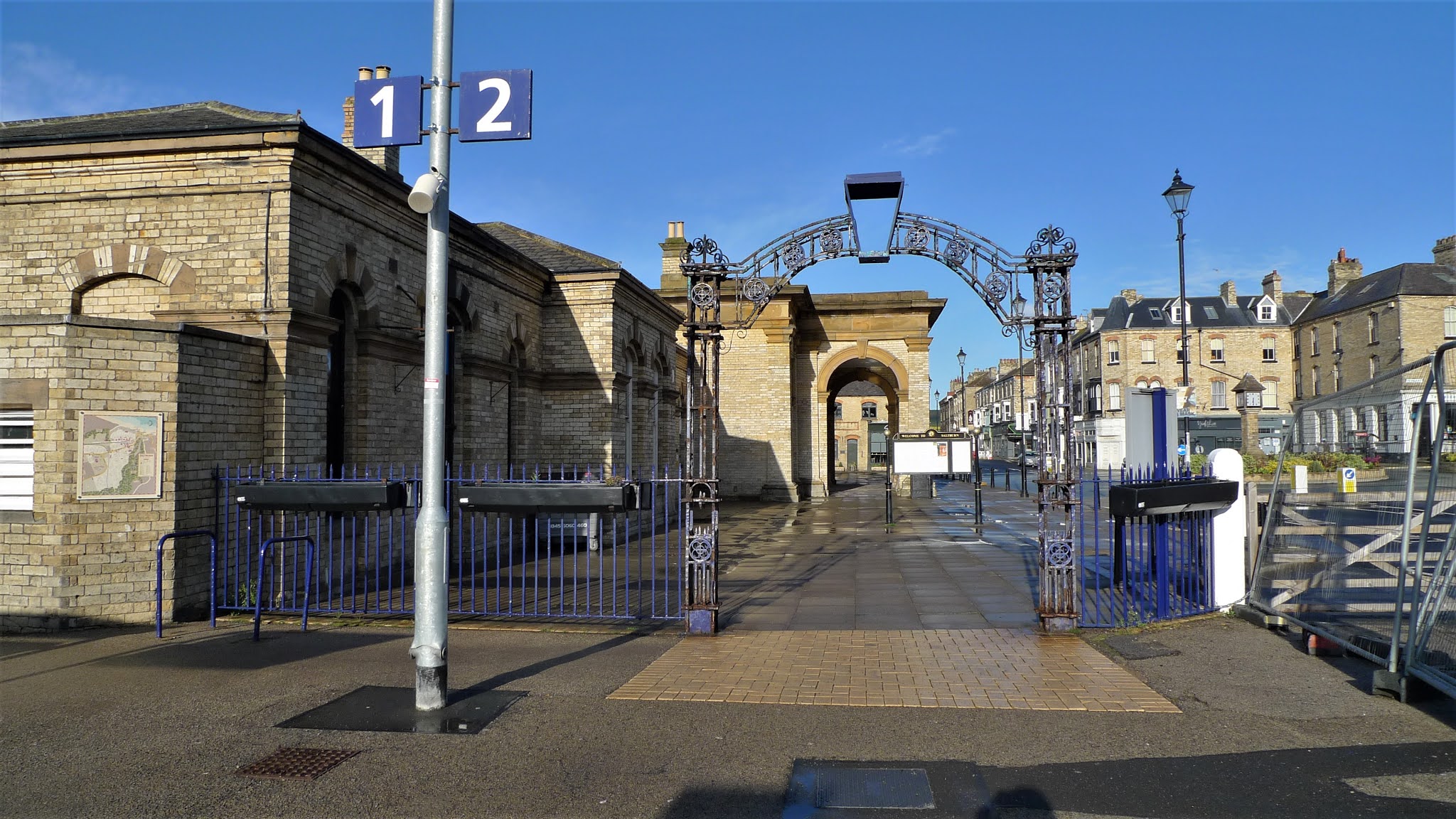
I went back to Fiona, and drove up to the top of the cliff, and parked there. I planned a circular walk, beginning with the station. The station approach was typical of many a Victorian seaside resort: a shop-lined avenue culminating in an important-looking station building, with the town clock set in front.


Despite the sign 'Railway Station', this grandiose entrance no longer sheltered tracks within. The interior had become a place for boutique shopping and culture - at least in normal times: the pandemic wasn't over yet. You could walk straight through. Off to the left was a Sainsbury's foodstore, at the end of the former platforms so to speak. The modern station was an open-air affair with shelters to wait in. It enjoyed a half-hourly service to Middlesbrough and beyond.


Where next? I chose a street at random and walked to the seafront, passing ordinary terraced housing and corner shops that could have been anywhere. Clearly not the posh end of Saltburn, but not at all tatty. It struck me that Saltburn was probably a place that Middlesbrough and Stockton people aspired to live in. Certainly, you'd enjoy fresh air.
On the upper promenade, a couple were admiring the next batch of rainclouds, which seemed to form a dark threatening mass on the horizon, and were coming closer. But I reckoned I'd make it back to Fiona before there was any risk of a soaking.


I think the industrial buildings on the horizon (left centre) could be the former British Steel Redcar plant.
There were good views of the cliff lift and pier.


Lining the road on the clifftop were a succession of large buildings of the hotel, pub or posh apartment sort. Definitely a solid statement (back in Victorian and Edwardian times) that Saltburn meant to be firmly on the holiday map.


This could be Eastbourne! A former grand hotel, now turned into apartments:


It was time to move on to Redcar. It was nearly 7.00pm, and I was getting hungry. But who knows when I might be in these parts again? Redcar was not to be missed. Another map.

It was drizzling when I arrived. I sat in Fiona, waiting for the rain to stop. The seafront didn't look encouraging.

I was parked outside a 'casino' - meaning a place where you could play the slots, and not a palace where sophisticated James Bonds in tailored tuxedos played Roulette, Blackjack and Texas Hold 'Em for fabulous sums. Mind you, there was nothing unsophisticated about the enticements to enter and waste one's cash. This poster caught my eye:

Two clean-cut, young men, in their late twenties or early thirties, with neat hair and nice shirts. Both of them intelligent, good humoured, self-assured, and clearly getting lots of fun out of playing the slots. In fact, the smiles on their excited faces suggest that they are on a winning streak. An impressionable passer-by might well think that he (or she) resembles them closely, and will have exactly the same experience. Just as well that Covid-19 restrictions meant that the place was shut.
The rain had stopped, and glorious evening sunshine had come back. I crossed the road, to see what that tower was all about, and to contemplate the beach.


It was called the Redcar Beacon. It wasn't a helter-skelter, although the design seemed to suggest it was. I think it was intended to be a focal point for the seafront, a day mark for strollers out on the sands, so that they wouldn't lose their bearings. And the sands were very extensive indeed. Some people were actually on them, and they must have been caught in the rain.


The rain clouds were definitely moving out into the North Sea, so I continued my walkabout. Across the road from the Beacon was this: Planet Kidz.

It incorporated Gabrielle's Ice Cream Parlour, which appeared to be the only 'seaside experience' to be had in Redcar at 7.30pm on a Monday evening in mid-May. I headed into the town centre. A wide shopping street came into view, with an elaborate clock tower at one end.


Surely, before the Beacon was built, this clock tower had been Redcar's main architectural statement? It was certainly handsome, and worth preserving. Next stop, the Central station. I anticipated that it would be old and impressive. I was right. The only thing, it was bricked up and fenced off. Its former main entrance was still on view, but to get to the platform for Saltburn trains you had to look for an opening at the side of the old station, ignoring that main entrance. I did find it, but it wasn't obvious where to go.


This seemed to be a very hole-in-the-wall way-in for a 'Central' station! But in fact the most-used access was nowadays over a footbridge from the other platform, on which all the modern facilities for tickets and waiting were situated. In effect, the station had been moved out of the old building and rebuilt alongside, out in the open.

I wondered what they would use the old station building for. Redcar seemed short on heritage and public venues of quality. I therefore hoped that it might become something useful. The old station at Richmond, for instance, had become an attractive cinema, gallery, restaurant and shopping complex. Why not the same here?
Back on the Saltburn platform, I discovered what mattered in Redcar: its people. A series of photographs - in panels - of residents, each with a story to tell, and collectively representing the spirit of the place, and maybe all of Teesside. The Redcar Faces Project.


Hmm. I photographed seven panels, and therefore twenty-one people. But there were twenty-five people in the project, so I must have missed a panel or two.
I found myself admiring the persons shown in the photos very much. They seemed so down-to-earth, so part of their community, and 'real' in a way I wasn't. I was merely another anonymous resident in my own community. I contributed nothing. I fostered no community spirit. I would never be asked to appear in a project like this, as a local personality who mattered to my village. I lived only for myself, and was arguably a lesser person for it.
Time was getting on, and it was nearly an hour's drive back to Richmond, my caravan, and the chance of a cooked meal - I didn't want to fall back on a takeaway. I headed back to the clock tower and walked down the pedestrianised shopping street. Gosh, it was a discouraging experience. It was a street on its commercial knees. They'd kept it clean and tidy, and there was even an artistic metal installation, to represent 'Redcar Man' I suppose.


But there were no shops of any quality left. I stood in front of the former Marks and Spencer store. The premises had been empty for several years already, with no takers. It looked dusty and sad.


There was a blue plaque on the wall - right edge in the upper of these two pictures. It was to commemorate the building's one-time occupation by Samuel Plimsoll, the man who (in Victorian times) agitated successfully for the adoption of loading marks on ships' hulls, so that they wouldn't be overloaded and therefore become dangerous to go to sea in. The 'Plimsoll Line', in other words. In my younger days, canvas shoes with rubber soles were generally called 'plimsolls', because where the rubber met the canvas reminded people of the Plimsoll Lines on ships. Mind you, at junior school in Barry in the 1950s we called these shoes 'daps'. (I must try to find out exactly why, although the Internet explanation is that 'daps' is an abbreviation of 'Dunlop Athletic Plimsoles', Dunlop the rubber-goods manufacturer having a factory in Bristol. Hmm. I'm not convinced)
An old man hobbled past, his shopping in a bag. He was the only other person on the high street.

Of course, away from this street, some shops were doing well. I noticed that B&M had lately opened nearby:

And a little later, after moving Fiona to the Tesco car park, I went into the store to go to the loo. They were doing a lively mid-evening trade. I asked the girl at the customer services counter for the best way out of town and back onto the A66 to Middlesbrough and Darlington. She was bright and friendly, even at 8.00pm, and gave me perfect instructions that I could remember and follow exactly. She was a credit to Tesco, and would have been a deserving contender in that Redcar Faces Project.

This was ridiculous. For the hundredth time, I promised myself that I'd buy a set of larger dinner plates. That has now been addressed - next post.


