'The Midlands' isn't a well-defined area of the country. You could say it is bounded by Wales in the west, the peak District in the north, the Fens in the east, and the Cotswolds in the south. Or, if speaking of towns and cities, by Shrewsbury in the west, Stoke-on-Trent and Nottingham in the north, Peterborough in the east, and Worcester and Northampton in the south; with Birmingham, Coventry and Leicester in the middle. But no two people would exactly agree.
Nevertheless, there are several things that distinguish the Midlands. One is the accent, of course. Another is the kind of food Midlanders seem to like. Butchers shops selling meat by the ton can be found everywhere. People here clearly like a substantial high-protein diet! And they like their carbs too. The butchers sell plenty of meat pies and pasties. All at tempting prices. Here's a shopfront display that caught my eye in Bridgnorth:
On my very first evening in Shropshire, I went to Ironbridge (of which more in the next post) and couldn't help noticing this dedicated pie shop:
Eley's Pork Pies. It had the air of a local institution. A man strode past me as I stood by. He was fortyish, vigorous, and built like a tank. 'Stocky', 'heavyweight', 'strong', 'gorilla arms', 'absolutely typical of a Midlands Man' were words and phrases that quickly sprang to mind. I guessed at a steady and habitual intake of beer and meat pies since childhood. Hooked on both, but especially pies. I followed him in. Sure enough, he was asking the lady there for two small meat pies. They were in three sizes: Man-sized, Giant-sized, and Super Elephant-sized. I had marked him down for a Super Elephant-sized pie, so his buying just two dainty little pies - the kind a man like him would easily inhale by accident and not notice - was a surprise. Perhaps he simply wanted a late-afternoon casual pie fix, something to keep him going while he walked to one of the pubs down the road. Like you might scoff a KitKat or Mars Bar while strolling somewhere.
All this said, he clearly knew his business. I decided to follow his excellent example. I asked the lady for one of the Giant-sized pies (these weren't really their offcial names, you understand, just what I thought they ought to be called), remarking that it would do for two meals, tonight and tomorrow. She smiled.
Back at the caravan, I carefully examined what I had bought:
Now that's a proper pie, and no mistake.
Well-filled, but still plenty of that lovely tasty jelly. Pinker than the typical Melton Mowbray pork pie from the East Midlands. In the West they clearly liked something different. The pastry was flavoursome. But the meat filling was something really special. It was absolutely succulent - and more seasoned than I'd ever before come across. The Eleys Secret Pork Pie Recipe clearly specified an above-average use of salt and pepper! It was delicious. It immediately crossed my mind to visit that shop again. But I resisted. I was strong. I knew that the way to true obesity lay open before me, and I was determined not to slide down that slippery slope. But I quite understood why Midlands Man loved fare like this, and why it became a natural habit to drop into a pie shop. Besides, there were smiles and good cheer to be had in such places. In my own experience, Midlands people are certainly very friendly, and very willing to chat. Just watch the men: they tend to make good-humoured but cheeky remarks if they sense you will play along with that kind of banter! I always choose to play along. It's fun. I like to laugh. And besides, I don't want them to think I'm a stuck-up Southerner from the Home Counties.
It wasn't just pies on their own. Everywhere there were cafés and lunch outlets offering 'pie and mash'. And 'hot roast pork' in baps and baguettes - with all the fixings. I couldn't completely ignore these. I'm only human.
So, on my day out in Shrewsbury, I found a lunch place near the station called Castle Banquet, and came away with a bacon, mushroom and onion bap, which I scoffed very messily on a sunny seat in the nearby Castle grounds.
Messy it may have been, with the filling falling out all over the place, but it was nice! And then, next day in Ludlow, this:
That's a big buttered bap containing gobbets of hot roast pork, carved before my very eyes, with apple sauce and a little stuffing. You could have the crackling in the bun, or (as here) a decoration on the top. It was a shop called Vaughans, run by a husband and wife, and of course we got talking. It turned out that they knew my home village in Sussex, and had very nearly opened a snack shop there. What a small world! Perhaps because of that little connection, or because we got on so well, my bap was supremely well-filled. It was almost too much; and over the next fifteen minutes, while I sat on a low stone wall in front of some ancient almshouses by the church, with people passing by, I thought I might have to leave half of it. 'Half' became just 'a little' however, and then suddenly I had consumed it all. Greed and appetite had trumped common sense. I waddled away like a bloated hamster.
And that wasn't my only food intake at Ludlow! I still wanted something to drink. I found myself in front of a likely place, called Wildwood Kitchen. Ah, this must be the company that had taken over from the famous De Greys Café. I'd always wanted to lunch at De Grey's. When I finally visited Ludlow on my own in 2014, with the notion of treating myself to an old-fashioned afternoon tea in elegant surroundings, I found that De Greys had died only weeks before. After decades and decades of offering upmarket refreshments to discerning customers, locals and visitors alike. I was so disappointed. It had occupied a timber-framed building, and must have started up during the 1920s. Local enquiry established that it had been excellent right up to its last day, and was now missed dreadfully. Its pricing policies hadn't moved with the times, though. The owners had refused to charge enough to maintain profits. So it had become a ridiculously cheap place to enjoy tea and cake and other specialities, with waitress service thrown in. This couldn't be sustained. Straightforward economics had closed it down. But now this new outfit, Wildwood Kitchens, had taken over. Hmm. From the outside, it looked much the same, although the 'De Greys' signage, so much a feature of local postcards, had all gone. In 2014, one could still see this:
In 2016, this. It really wasn't much different:
There were two distinct parts to the premises. Out front, a space that in the De Greys days had looked like a very posh cake shop, all chrome counters and marble, with a black-and-white motif. Further in, somewhere you could sit down. There were still cakes on sale. But now also some beautifully-presented salads:
Not for pie-chomping Midland Man, this! Replete from my hot roast pork bap, I wanted only coffee - an Americano, black, no sugar. But I also chose a lemon tart for a small dessert. A pleasant girl led me through to the rear.
The Café part was long and narrow, but well-lit from side windows. Right at the back was a plush area with comfortable seating (where I was put). Beyond that, a paved rear garden if you wanted sunshine and a breeze. Surely all this was original De Greys? I asked one of the waitresses. Yes, Wildwood had kept most things unchanged. A sound move, I thought. This kind of ambience was exactly what the customers would like. It was pleasant, relaxing, traditional. My coffee and tart came. They were excellent.
Wildwood's prices weren't too bad. Considering the surroundings, the service, and the quality of the food and refreshments, I was expecting to pay through the nose. But no.
In fact I wished I'd known how it would be. I would then have lunched properly there, and forsworn any hot roast pork baps.
The place was clearly very popular, and was filling up fast. To my left, a young couple with a baby were tucking into salads. The baby was very well-behaved. I learned from the Italian mother that he was just seven months old. They lived in Cardiff. To my right, two young women were tucking into mussels and linguine. They commiserated with me about making the wrong lunchtime decision. But of course, I could come back on a future holiday, and really I was in no way dissatisfied with my takeaway bap, simply as something tasty to quell my hunger with. But I'd have preferred their kind of lunch! With a glass of wine.
I used their loo while there. This had an unusual mirror in it, allowing you to see the top, back and sides of your head:
Clearly an art-deco survival from the early De Greys era! Like me.
This was a Saturday, and Ludlow had a lively street market going on, with stalls even in the side-streets. There were an unusual number of food shops close to the market square. All kinds of yummy goodies, like cheese, in those!
I'd noticed the same thing in Shrewsbury: lots of upmarket food and delicatessen shops. Similarly in Leicester, which I visited back in June. The Midlands was, one way or another, a foodie paradise. So if you want to lose weight, do not go there.
Wednesday, 17 August 2016
Tuesday, 16 August 2016
My TV and Radio career
'Career' is way too strong a word! But I have had two genuine encounters with media people over the years.
The first occurred in early November 1993, at Laugharne in west Wales. Laugharne is the place where the poet and radio playwright Dylan Thomas ended up. He acquired a boathouse down on the river estuary, overlooked by a shack in which he painstakingly crafted his poems. Here are the pictures I took then of the boathouse:
I was in the area on a late-season holiday break with Mum and Dad, and we visited the little town. I was at first a little disappointed that Laugharne is not much like the fictional village described in Thomas' radio play Under Milk Wood. I learned later that he had in mind Old Fishguard, which when I saw it in 2008 looked like this:
Anyway, Dad had had double-knee replacement surgery earlier that year, and didn't want to walk far. Mum wanted to stay with him. So I set off on my own to quickly see the boathouse. It was a damp morning, but otherwise dry and mild for the time of year.
The boathouse didn't have a garden as such - just a reasonably spacious paved patio. I saw a couple of people down there, and a maintenance chap. Descending from the clifftop, I had already decided that I wouldn't have enough time to go into the boathouse and stay a while: it would be unfair to leave Mum and Dad too long. A rapid exterior examination would have to do. This brought me onto the patio, whereupon the two people came over and introduced themselves. A man and a woman. I didn't catch his name, but I'm pretty sure her name was Penny.
They were filming for S4C (the Welsh equivalent of Channel 4), the theme being Dylan Thomas, his boathouse, and the sort of people who came to visit it. They'd been hanging around for nearly two hours, without anybody turning up. But now they had me. They simply wanted shots of me looking at the property and taking photographs. I was an especially suitable visitor because I was carrying not one, but two cameras, and was clearly someone with a keen eye for a picture! I duly obliged. I'm not quite sure, but I think they asked me to say a few words about my experience. All this was filmed. I quite enjoyed it. It would become part of a TV programme to be screened in early 1994.
Here they are. I got them to pose for me, as a souvenir of the occasion:
I never saw the programme. You could only watch S4C in Wales. Nobody got in touch to offer me a contract.
Forward now to August 2016. It's Bridgnorth in Shropshire. Bridgnorth is a nice town, set right up on a sandstone hill. and overlooking the River Severn. It has an impressive olde-worlde main street, dominated by a market hall:
It was a bit windy underneath those arches!
I must have looked a bit of a scarecrow when I left the hall to move on down the street, but despite this, a man bounded up and accosted me. His name was Nigel Bolman, and he worked for the BBC. I got a picture of him, shot from the hip:
He was interviewing members of the public about the 2016 Olympic Games, then in full swing at Rio de Janeiro - but with a twist. Lots of medals were being awarded. But who did I think ought to be getting a medal, but wasn't likely to? The answers would form part of a radio programme.
It was an opportunity to shine. I am rarely short of words. But I do sometimes misunderstand questions put to me. I was very slow on the uptake here. At first I thought he wanted me to reel off a list of B-list athletes who deserved a medal. I confessed at once that I had taken no interest whatever in the Olympics, and couldn't name anyone. No, not athletes: ordinary people whose labour and dedication merited recognition. I still thought he wanted me to name names. I couldn't think of any. My mind was blank. No, types of people I knew about. Ah! Well...all I could think of were people in my circle who spent a big chunk of their waking lives caring for other people, such as elderly relatives. Which wasn't at all highly original as an answer .
By this time I felt I had disappointed him. I had been hard work. And his dogged perseverance had not struck gold. True, he had held the mike close and had recorded every word, but somehow I knew that he wouldn't be using any of that. I felt a little foolish for not grasping at once what he'd wanted, and more than a little sorry for failing to say anything sensible or coherent. I had wasted his time.
It was an amiable enough parting, but I put that down to his good professional manners. He was probably muttering 'stupid, ignorant woman' under his breath.
Of course, it may be that 95% of all persons approached out of the blue in the street, and asked to give succinct and intelligent answers, would - like me - be unable to extemporise. That thought was some comfort. And I had been a willing and co-operative interviewee. I'd fumbled, but nevertheless I had sincerely attempted to give him was he was looking for. All the same, I knew my radio career was over.
The first occurred in early November 1993, at Laugharne in west Wales. Laugharne is the place where the poet and radio playwright Dylan Thomas ended up. He acquired a boathouse down on the river estuary, overlooked by a shack in which he painstakingly crafted his poems. Here are the pictures I took then of the boathouse:
I was in the area on a late-season holiday break with Mum and Dad, and we visited the little town. I was at first a little disappointed that Laugharne is not much like the fictional village described in Thomas' radio play Under Milk Wood. I learned later that he had in mind Old Fishguard, which when I saw it in 2008 looked like this:
Anyway, Dad had had double-knee replacement surgery earlier that year, and didn't want to walk far. Mum wanted to stay with him. So I set off on my own to quickly see the boathouse. It was a damp morning, but otherwise dry and mild for the time of year.
The boathouse didn't have a garden as such - just a reasonably spacious paved patio. I saw a couple of people down there, and a maintenance chap. Descending from the clifftop, I had already decided that I wouldn't have enough time to go into the boathouse and stay a while: it would be unfair to leave Mum and Dad too long. A rapid exterior examination would have to do. This brought me onto the patio, whereupon the two people came over and introduced themselves. A man and a woman. I didn't catch his name, but I'm pretty sure her name was Penny.
They were filming for S4C (the Welsh equivalent of Channel 4), the theme being Dylan Thomas, his boathouse, and the sort of people who came to visit it. They'd been hanging around for nearly two hours, without anybody turning up. But now they had me. They simply wanted shots of me looking at the property and taking photographs. I was an especially suitable visitor because I was carrying not one, but two cameras, and was clearly someone with a keen eye for a picture! I duly obliged. I'm not quite sure, but I think they asked me to say a few words about my experience. All this was filmed. I quite enjoyed it. It would become part of a TV programme to be screened in early 1994.
Here they are. I got them to pose for me, as a souvenir of the occasion:
I never saw the programme. You could only watch S4C in Wales. Nobody got in touch to offer me a contract.
Forward now to August 2016. It's Bridgnorth in Shropshire. Bridgnorth is a nice town, set right up on a sandstone hill. and overlooking the River Severn. It has an impressive olde-worlde main street, dominated by a market hall:
It was a bit windy underneath those arches!
I must have looked a bit of a scarecrow when I left the hall to move on down the street, but despite this, a man bounded up and accosted me. His name was Nigel Bolman, and he worked for the BBC. I got a picture of him, shot from the hip:
He was interviewing members of the public about the 2016 Olympic Games, then in full swing at Rio de Janeiro - but with a twist. Lots of medals were being awarded. But who did I think ought to be getting a medal, but wasn't likely to? The answers would form part of a radio programme.
It was an opportunity to shine. I am rarely short of words. But I do sometimes misunderstand questions put to me. I was very slow on the uptake here. At first I thought he wanted me to reel off a list of B-list athletes who deserved a medal. I confessed at once that I had taken no interest whatever in the Olympics, and couldn't name anyone. No, not athletes: ordinary people whose labour and dedication merited recognition. I still thought he wanted me to name names. I couldn't think of any. My mind was blank. No, types of people I knew about. Ah! Well...all I could think of were people in my circle who spent a big chunk of their waking lives caring for other people, such as elderly relatives. Which wasn't at all highly original as an answer .
By this time I felt I had disappointed him. I had been hard work. And his dogged perseverance had not struck gold. True, he had held the mike close and had recorded every word, but somehow I knew that he wouldn't be using any of that. I felt a little foolish for not grasping at once what he'd wanted, and more than a little sorry for failing to say anything sensible or coherent. I had wasted his time.
It was an amiable enough parting, but I put that down to his good professional manners. He was probably muttering 'stupid, ignorant woman' under his breath.
Of course, it may be that 95% of all persons approached out of the blue in the street, and asked to give succinct and intelligent answers, would - like me - be unable to extemporise. That thought was some comfort. And I had been a willing and co-operative interviewee. I'd fumbled, but nevertheless I had sincerely attempted to give him was he was looking for. All the same, I knew my radio career was over.
Saturday, 6 August 2016
Not to be seen again for generations
Anyone still working their socks off in an office might wistfully study the above picture. They may never get the chance to attend something like this. They may never find themselves sitting around like that, ready to hear a relaxed morning of anecdote and practical advice, all about the pitfalls and problems of retirement - taken early or at the normal time - followed by an afternoon devoted to finance.
It was a Retirement Course. The one I attended in May 2005, when still only aged fifty-two. A two-man team from a firm of pension and investment consultants had been hired by my Department to present a talk to people who were taking retirement. In my own case, an early retirement method called 'Approved Early Severance'.
AES was a particular kind of one-off deal for those over fifty but under sixty. You couldn't ask for it. It was offered out of the blue now and then, when government policy dictated that staff had to be got rid of. Only a limited number would get approval, with a strict pecking order if the deal were over-subscribed. So you'd need to be lucky.
AES wasn't a generous, gold-plated way to get early retirement. You might be entitled to only a meagre pension. You'd be interested if the figures worked out well enough, but not otherwise. I had been in the Department for nearly 35 years, and so the figures did work out. I would not be rich, but I'd be comfortable.
Even so, I'd have to say goodbye to a third of the pension I would have got, if I'd hung on for another eight years until sixty, which was my personal 'normal' retirement age. But it seemed worth the sacrifice. Eight extra years of freedom and leisure, when still young enough and healthy enough to really appreciate it - of course it was worth it.
But unlike most in that room, I wouldn't get a lump sum. I had already, some years before, jumped into a new Departmental pension scheme which gave me extra pension, but no lump sum. In making that choice, I was taking a long-term view. Any lump sum would soon be gone - mainly on repaying the mortgage - but extra pension would be there forever - month after month after month until I died. I wanted that. So I had nothing to invest, and the 'investment afternoon' wouldn't be directly useful to me. But the morning was.
It was only two weeks before my last-ever day at the office. I was still working hard on my cases, but the last interviews were fixed up, the last settlement proposals had been made, and nothing fresh was going to land on my desk. I'd more-or-less wound up my affairs. I was carefree and relaxed, pretty well in a holiday mood. Attending a Retirement Course was a nice way to spend one of my last days. It meant a trip into central London too. I was conscious that I might not see central London much, the City anyway, once I'd gone. I made a point of recording the commuter scenes on arrival at London Bridge station, and as I walked across London Bridge into the City:
The classic race to the office. Brisk walking, bowed heads, hazy sunshine. The sights of London, such as Tower Bridge in the background, completely taken for granted. But I didn't take them for granted. I saw them with a tourist's eye. A tourist who might not return very often, and certainly never again this early in the day. I didn't love London, so there was no pang, but I did feel a curious sensation of an era passing, and of saying farewell. The phrase 'goodbye to all that' went through my mind. (It was the title of Robert Graves' autobiography)
I was looking forward to the day, but I didn't expect to learn anything I hadn't already thought of. I had been imagining life in retirement for a long time past. I thought I knew well enough what it would be like, and how I would fill my time. In that I was only partially correct. I hadn't thought of everything, not by any means.
Nevertheless, I settled down to enjoy the morning's talk. And it was a treat. The chap who spoke to us was a really friendly person, someone you could warm to like a favourite uncle. He was brimful of anecdotes about former colleagues who had taken retirement and how they had got on - and what lessons could be drawn. I started to pay close attention. There was more in this than met the eye! In story after story he revealed how life in retirement might be hard work. Or at least, a life for which one needed to have some definite coping strategies. And these had to be in place before the final day at the office.
Yes, there was that wonderful initial euphoria. And why not wallow in it? Thoroughly! But then, after the first few days at home, it was vital to get into fresh new habits that would get one out of bed early, and ensure that laziness and indolence and a general sluggishness of mind didn't take hold.
It didn't matter too much what one did, so long as sitting around on the sofa all day wasn't part of it. One needed a couple of hobbies, active ones if possible, and a few projects to think about and get on with. It didn't matter what they were, so long as they stirred one into an alert and active state of mind, and kept one fit.
Too many people relied on home shopping, holidays and family responsibilities to keep them busy in the future. They could all certainly fill one's time, but they were not necessarily one's special personal choice. It was so important to have interesting, personally-important, and - if at all possible - challenging things to get on with. Such as learning a brand new skill, and then putting it to use. Making things, perhaps. Studying something, with some definite end in mind. Something anyway chosen by oneself, and not just done as a household chore or as a family commitment. Life should be more than mowing the grass, pushing around a supermarket trolley, or babysitting the grandchildren.
Getting right out of the house, and mixing with new people, were other vital things. The social network at the office had vanished. This had to be replaced. If not already a member of, say, a social or sporting club, then voluntary work might be the answer; and for that a free pair of hands was the only essential requirement.
Or why not a full-time job? And earn a little extra from it too? We heard from him about a chap, a former office manager, who had got idle and fat and very unfit just sitting around. The deterioration was very marked, and it made him very grumpy. He had no hobbies. He'd never developed any. Nor was he the sort to invent active things to do - he didn't possess the right imagination. And then someone steered him into becoming a postman. Within months he was a changed person. Fit again, cheerful, and enjoying the vigorous outdoor life in all weathers.
Hmm. I'd thought that my camera and caravanning would together do the trick for me. Clearly that might not be so. I stopped pooh-poohing the need for retirement advice, and got thinking about other things I might do to keep me well, and avoid stagnation.
The afternoon session with the other man was rather different. It was sharper, with a hard focus on where to best put that lump sum. That congenial morning had softened us up for the kill.
We'd finished with the amiable uncle. This was a salesman talking. In fact, I began to think we were all getting too much of the hard sell. Granted, he made all the various investment options clear, including putting cash in bonds and other value-preserving products. This was of course 2005, three years before the Recession, and still an era of high interest rates and big bonuses on any money put away. There were a staggering number of different investment vehicles to consider. But I thought - and clearly several other people thought the same - that he was making some big unwarranted assumptions about what we might be willing to do with our resources. Another woman from my office, who was taking early retirement with me, intended to buy a bigger house with her husband, and lump-sum bond purchases were no part of their retirement plans. Yet this man was passing around papers, asking everyone for full particulars of their present financial state, and for their contact details. Ominous! She said she might slip away at the next coffee break, and not stay to the end. She wasn't alone in whispering that.
Certainly the hard sell was all wrong. It was unexpected and we didn't want it. In any case, high-up tax inspectors might be expected to be pretty savvy where money matters were concerned, and to know what was on the market, and which financial products might suit them. I stayed to the end, but had a cast-iron let-out: I wasn't going to get a lump sum. I secretly relished saying so to the man, when he asked me why I hadn't filled in his questionnaire. He had taken it for granted that I'd become a client.
Then I went home. The hard-sell 'nasty man' - he wasn't really nasty, just doing his job - had tarnished the day's experience somewhat, but I was still giving a lot of thought to the stories and advice given by the 'nice man' during the morning. Nevertheless, I didn't neglect to photograph passing scenes on the Underground:
And did I become a postie? No. Or a charity volunteer? No. Did I become a fat couch potato? Again, no. I avoided all of these.
M--- and I had three fulfilling years before the rot set in. We went together to lots of places, and even travelled to New Zealand and back. But I'd had to sell my house, and I wasn't quite happy presuming on M---'s goodwill by sharing her home for a while. And I did feel the loss of my job, my colleagues, and all the former structure of my day. Eventually I seemed to be living hour by hour, without any definite plans. I had a pleasant, easy life, but it was purposeless. I could almost say meaningless. Even our joint investment in Ouse Cottage was in fact M---'s pet hands-on project, rather than mine, and she had all the fun and satisfaction to be had from it. I began to experience what the nice man on the Retirement Course had been warning against. This set the stage for deep introspection and its consequences.
And nowadays, eleven years on from retirement day? Well, I've put on weight, and could do with more exercise, but on the whole I'm looking good, I'm well occupied, and I feel very happy. I lead an interesting well-planned life, with objectives in view all the time, every day. I have ambitions, things to look forward to, and I do not drift.
So no regrets about retiring early. Indeed, my life might have turned out very differently if I'd stayed on at work till sixty. Eight more years of stress, in exchange for more pension. Eight more years of a tiresome job, and tiresome role-playing, just so that I might get an extra few thousand pounds to play with each year.
I did the right thing. Freedom is beyond price.
Friday, 5 August 2016
The Laughing Sailor
How frightening many 'children's amusements' used to be! This post is - digressions apart - about one kind of jolly amusement that I'd forgotten, but recalled with some personal discomfort recently.
I'd put Fiona into the Volvo dealer's to have her rear suspension bushes replaced. They were a bit knackered after almost 92,000 miles of motoring on the bumpy roads you get in this country. The job entailed a lot of dismantling and then putting things back together again, and would take several hours. So I decided to take the train to Portsmouth, and spend some time there. A return ticket on the local bus from the dealer's to Lancing station was £4.30. A day return rail ticket from Lancing to Portsmouth Harbour was £8.85 with my Senior Railcard discount. Blimey, guvnor, that was £13-odd blown already! But I hadn't visited Pompey for some time, and exploring the old part of it would be interesting. 'Pompey', by the way, is the traditional affectionate name for Portsmouth. Nobody knows for certain how the city ever came to be called that. 'Tis my belief, however, that it must have something to do with the Royal Navy's presence there.
Apart from being England's premier Naval Base, Portsmouth is also a modern ferry port, a top-notch university city, and is a generally buzzy place to be. If you want to get to the Isle of Wight from London or anywhere in South-east England, then you will almost certainly go via Portsmouth. The same is true if you are heading for France, Spain or the Channel Islands. And the Gosport Ferry is the only practical way for people living in the big town of Gosport, just across the harbour, to get to Portsmouth for work and decent shopping.
Portsmouth tightly fills Portsea Island, and apparently it's the most densely-packed city in the country, with some amazing figure of persons-per-square mile. But nevertheless its southern part, known as Southsea, is a spacious resort with lots of continuous green open space behind the beach. Southsea people tend to think of 'their' part of Portsea Island as a distinctly separate town. In truth you can't say where Portsmouth proper ends and Southsea proper begins - they have been joined as one for more than a hundred years. But they do have very different atmospheres. On this visit I wanted to see some history, and sample the busy life of a major port, and not seek out the sunny seaside delights of a beach resort. However, as you will see, this post is based on an exhibition about Southsea in Portsmouth Museum.
Wikipedia have a comprehensive write-up on Portsmouth here: https://en.wikipedia.org/wiki/Portsmouth.
Portsmouth has two stations, Portsmouth & Southsea, which is right in the city centre (alight for the shops and university) and Portsmouth Harbour (for all the passenger ferries, the Historic Dockyard, the big Gunwharf Quays shopping complex, and the Spinnaker Tower). You'd think that the city centre station would be the main one, but the Harbour station is bigger and busier. Here I am, just arrived:
I didn't really have enough time to hop across to the Isle of Wight, so I chose the obvious second-best, and have a look at Gosport instead. I'd never actually seen its waterfront and High Street. The Ferry was down the side of the Harbour railway station. Crossing the harbour on a boat strongly reminded me of crossing the Mersey from Birkenhead to Liverpool in 2014. Gosport, of course, is no Liverpool. Was it worth the effort? Well, the ferry terminal at Gosport was certainly modern and imposing, and there was a nice little park there with flowers in it, and this mosaic of the Atlantic was rather well-executed, I thought:
The park celebrated not only Gosport's 1944 D-Day role in the Second World War, but its part in the 1982 Falklands Campaign.
Moving away from the waterfront, and up the High Street, I did my best to keep an open mind. But really there wasn't a lot to enthral me. Put it this way: if a good collection of discount shops is your ruling passion in life, then go to Gosport. The place had them all, and they seemed to be thriving. I saw, for instance, Poundland, Poundstretcher and Poundworld all in the space of a few yards. Peacocks and Shoe Zone? Check. Amusement arcade? Check. Betting shops? Check. You get the idea. I looked for Waitrose in vain. This said, the combined Library and Museum was a joy - a vibrant, interactive place to take your kids to, with a friendly café to boot. And I found a gallery, and the Local Records Office, which had a section devoted to the local geology, genuinely worth five minutes of anybody's time.
A noticeboard caught my eye in the curiously-named Nat Gonella Square. It was about the man of that name. Nat Gonella (1908-1998) was a famous trad jazz bandleader, very influential in Britain, and for the last twenty-odd years of his life a resident of Gosport. See https://en.wikipedia.org/wiki/Nat_Gonella.
I wondered if there had ever been any other famous Gosport residents, but I didn't come across them. So having seen all of this, I next decided to tear myself away and recross the harbour on the ferry. It was time to forsake Gosport and really get to grips with historic Portsmouth! I have to say, the views from the ferry were abundantly worth the £2.30 return fare (that's £2,30 with a Senior Concession, mind you: young whippersnappers pay rather more).
My new objective was Portsmouth Museum. From experience, I knew that I would find loos there, and something inexpensive to eat for lunch. But first, a walk around Old Portsmouth. My route took me to an area known as The Point, which was where the jack tars of old used to do their drinking and whoring, but which is now a characterful residential area - though not overly expensive, I thought. It was full of old Citadel walls and gates and turrets, with Things Nautical at every turn, and everywhere references to Admiral Lord Nelson, the same National Naval Hero I encountered up in Norfolk only a month ago.
There was a stout stone harbour wall to repel invaders, with a shingle beach below. The harbour and, out to sea a bit, Spithead, were thronged with boats of all kinds, including the Isle of Wight ferries. I really must plan a day visit to the Island before the year is out.
At last, the Museum. I had a toasted cheese and ham sandwich that must have used up all the spare cheese in the city, so smothered in cheddar was it. Tasty, though. A good pot of tea washed it all down. I then had a look at the exhibits. They made much of the Famous Persons connected with Portsmouth and Southsea. Apart from Nelson, there was for instance Isambard Kingdom Brunel, Charles Dickens, Arthur Conan Doyle (author of the Sherlock Holmes books), H G Wells, and many others including several well-known bands and artistes in the music business. When District Inspector of Portsmouth 4 Tax Office around 1971, I remember my Dad saying that working at his office as a lowly Tax Officer was an ex-bandmember of Simon Dupree and the Big Sound, which had a big pop hit called Kites in 1967. I imagine he was one of the musicians that the three Shulman brothers, who headed the band, got rid of for not playing well enough for their liking. Clearly, if you were not a top chart success, or had been sacked from a band, then you needed a daytime job to get by! Actually, being a TO wasn't at all a bad job to get, as office jobs go, but I imagine it was unbelievably humdrum for the chappie, because later on Dad mentioned that he'd left.
There was a big exhibition about Sherlock Holmes, but the section of the Museum that most got my attention was the one to do with Southsea.
All kinds of traditonal seaside things were on display, some of them with a funfare flavour. And I found myself confronted with this. The Laughing Sailor, although here called Jolly Jack.
Oh dear. Anything but jolly to me. I instantly remembered being frightened to death by this kind of laughing dummy when I was a child. When you inserted a coin - it might have been 1d (one old penny) in those days - this rather grotesque figure would move backwards and forwards, emitting a strange kind of recorded noise, meant to be uncontrolled and infectious laughter - though to me it sounded more like a malevolent snarl. I found it nightmarish. The movements were stiff and unnatural, and of course the facial expression didn't change, so the snarling laugh seemed weirdly disembodied and creepy. As if an animated corpse were cavorting about while someone else 'laughed' at you through a hidden loudspeaker.
I can't understand how this was ever thought suitable for children. I remember being wary and jittery with real-life 'characters' one met on quaysides. This horrible dummy was even worse. I can only think that once upon a time humour was cruder, and kids had so little in the way of diversions that even this could be found entertaining.
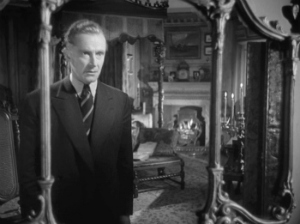
Then again, I have never liked anything resembling a ventriloquist's dummy. As an older child, I saw Dead of Night, a film made in 1945 - see https://en.wikipedia.org/wiki/Dead_of_Night - which I mentioned in my post Dreams that might come true on 2 November 2011. The film is about an architect who has a recurring and very vivid dream in which he visits a house and meets a certain set of people. Through repetition, he gets to know who they are. They always do and say the same things. The dream has direction, too, drawing him towards some horrific ending, although he never gets to that ending, and wakes up before it - whatever it is - actually happens.
The film has him waking up, having breakfast, saying goodbye to his wife, and setting forth to visit the home of a new client. A perfectly normal day. He is no more than thoughtful as he arrives, astonished to find that it is the house in his dream.
But he is bemused, and then increasingly worried, when he begins to experience the events of the dream, replicated in almost every detail - and this time for real. The people he encounters are equally bemused, and think it can all be explained quite naturally. This leads on to their telling various stories, one by one, about odd or disturbing things they have experienced, that must have been mere imaginings, even if at the time there was a strong flavour of the supernatural. They all mean to reassure the architect, but as time passes the horror steadily grows.
The stories are various. One of them is a whimsical tale of two golfers who love the same woman, and who flip a coin to see who will push off to leave the field clear, and who will stick around and profess his love. The honourable loser - I think he loses through an underhand trick - heads towards a water hazard and drowns himself, but afterwards returns to haunt the winning contender. The teller of that one admits he has made it up.
But most of the stories are not so light-hearted, and are 'true'. Such as the one related by a man who'd had, while ill and feverish, a very odd 'waking dream' that gave him warning of death. In the dream he finds himself staring at a hearse, and an undertaker saying to him, 'Room for one inside, sir.' Then, once well again, he is routinely waiting at a bus stop. A bus comes along, almost full up. And the conductor, who looks exactly like the undertaker in the dream, says, 'Room for one inside, sir.' Startled, he hesitates, then refuses to get on board - which saves his life. Soon after moving off, the bus gets out of control and there is a dreadful crash with many killed. One of the dead would have been him.
Or a newly-married couple's story, about the purchase of an antique mirror that at night reflected not the modern room it had been hung up in, but a sinister fire-lit bed-chamber of long ago.
At first only the husband sees that chamber, not his wife. Even if she is standing next to him as he looks at the mirror, and holding him lovingly, he still sees only himself reflected. And he is standing in a room full of foreboding and menace. This fills him with horror. He tries to fight the awful vision, and at first can banish it, but soon he can't, and it starts to affect him. His personality changes, and he begins to become nervy, harsh, and then cruel. In a final scene he and his wife - by now she has suspicions about this mirror - fight each other in front of it as, in his uncontrolled anger, he starts to strangle her.
As he does so, she sees - for the first time - the evil fire-lit bed-chamber, now with both of them in it. She manages to grab a brass candlestick, and smash it against the glass, which thankfully breaks the spell. The husband instantly returns to his normal self, and they destroy the mirror, learning afterwards that it came from the house of a man who murdered his wife in that fire-lit room a hundred years before.
Creepy enough. But the story that really frightened me concerned a man who begins as a skilled stage and private-party ventriloquist with a promising career. But the dummy tends to get out of control during the act, and makes inappropriate remarks to the audience, which both amuse and shock them.
It seems the dummy has a mind of his own. When they are alone, the ventriloquist speaks to the dummy as if he were an actual person, getting nasty remarks in reply. In fact the dummy has notions that he is much the better half of their act, and taunts his owner with a sneering voice. In one scene, the ventriloquist tries to shut the dummy up, pressing his fingers against the dummy's mouth to muffle him. But the dummy bites his fingers, and draws blood.
And so on. Clearly the man has schizophrenia, and is projecting more than just his voice onto the dummy. He is imagining the dummy to be alive, and a rival. He goes mad. In the asylum, the schizophrenia rapidly escalates, with the dummy eventually taking over. That's not the end of it, though, because the dummy is part of the architect's ultimate nightmarish fate.
While the story progresses, we see the dummy starting to do and say things by himself - like sitting up, and turning his head - even when not being held by the ventriloquist. And all the time, the dummy is speaking vindictively in that odd voice that stage dummies have, and mocking its owner in a laugh just like a Laughing Sailor's - or Jolly Jack's. Visually, it's hard to tell them apart.
So I hope you can see how unhappy I was to discover this exhibit. The bad feeling I have about things like this has never got less. Of course, I was morbidly fascinated enough to take some shots with my camera; but I didn't pop in the 20p required to make Jolly Jack heave about with mirth, and laugh his head off. I didn't want to hear that well-remembered noise.
I am sure that my aversion towards Laughing Sailors or Policeman or whatever is not unique. I rather think that most people find animated dummies creepy and highly disturbing.
Here's a thought: when domestic robots or androids become commonplace, as they may do within twenty years, let's earnestly hope they are not like this. Imagine: the Laughing Android...presumably having the last laugh of all.
I'd put Fiona into the Volvo dealer's to have her rear suspension bushes replaced. They were a bit knackered after almost 92,000 miles of motoring on the bumpy roads you get in this country. The job entailed a lot of dismantling and then putting things back together again, and would take several hours. So I decided to take the train to Portsmouth, and spend some time there. A return ticket on the local bus from the dealer's to Lancing station was £4.30. A day return rail ticket from Lancing to Portsmouth Harbour was £8.85 with my Senior Railcard discount. Blimey, guvnor, that was £13-odd blown already! But I hadn't visited Pompey for some time, and exploring the old part of it would be interesting. 'Pompey', by the way, is the traditional affectionate name for Portsmouth. Nobody knows for certain how the city ever came to be called that. 'Tis my belief, however, that it must have something to do with the Royal Navy's presence there.
Apart from being England's premier Naval Base, Portsmouth is also a modern ferry port, a top-notch university city, and is a generally buzzy place to be. If you want to get to the Isle of Wight from London or anywhere in South-east England, then you will almost certainly go via Portsmouth. The same is true if you are heading for France, Spain or the Channel Islands. And the Gosport Ferry is the only practical way for people living in the big town of Gosport, just across the harbour, to get to Portsmouth for work and decent shopping.
Portsmouth tightly fills Portsea Island, and apparently it's the most densely-packed city in the country, with some amazing figure of persons-per-square mile. But nevertheless its southern part, known as Southsea, is a spacious resort with lots of continuous green open space behind the beach. Southsea people tend to think of 'their' part of Portsea Island as a distinctly separate town. In truth you can't say where Portsmouth proper ends and Southsea proper begins - they have been joined as one for more than a hundred years. But they do have very different atmospheres. On this visit I wanted to see some history, and sample the busy life of a major port, and not seek out the sunny seaside delights of a beach resort. However, as you will see, this post is based on an exhibition about Southsea in Portsmouth Museum.
Wikipedia have a comprehensive write-up on Portsmouth here: https://en.wikipedia.org/wiki/Portsmouth.
Portsmouth has two stations, Portsmouth & Southsea, which is right in the city centre (alight for the shops and university) and Portsmouth Harbour (for all the passenger ferries, the Historic Dockyard, the big Gunwharf Quays shopping complex, and the Spinnaker Tower). You'd think that the city centre station would be the main one, but the Harbour station is bigger and busier. Here I am, just arrived:
I didn't really have enough time to hop across to the Isle of Wight, so I chose the obvious second-best, and have a look at Gosport instead. I'd never actually seen its waterfront and High Street. The Ferry was down the side of the Harbour railway station. Crossing the harbour on a boat strongly reminded me of crossing the Mersey from Birkenhead to Liverpool in 2014. Gosport, of course, is no Liverpool. Was it worth the effort? Well, the ferry terminal at Gosport was certainly modern and imposing, and there was a nice little park there with flowers in it, and this mosaic of the Atlantic was rather well-executed, I thought:
The park celebrated not only Gosport's 1944 D-Day role in the Second World War, but its part in the 1982 Falklands Campaign.
Moving away from the waterfront, and up the High Street, I did my best to keep an open mind. But really there wasn't a lot to enthral me. Put it this way: if a good collection of discount shops is your ruling passion in life, then go to Gosport. The place had them all, and they seemed to be thriving. I saw, for instance, Poundland, Poundstretcher and Poundworld all in the space of a few yards. Peacocks and Shoe Zone? Check. Amusement arcade? Check. Betting shops? Check. You get the idea. I looked for Waitrose in vain. This said, the combined Library and Museum was a joy - a vibrant, interactive place to take your kids to, with a friendly café to boot. And I found a gallery, and the Local Records Office, which had a section devoted to the local geology, genuinely worth five minutes of anybody's time.
A noticeboard caught my eye in the curiously-named Nat Gonella Square. It was about the man of that name. Nat Gonella (1908-1998) was a famous trad jazz bandleader, very influential in Britain, and for the last twenty-odd years of his life a resident of Gosport. See https://en.wikipedia.org/wiki/Nat_Gonella.
I wondered if there had ever been any other famous Gosport residents, but I didn't come across them. So having seen all of this, I next decided to tear myself away and recross the harbour on the ferry. It was time to forsake Gosport and really get to grips with historic Portsmouth! I have to say, the views from the ferry were abundantly worth the £2.30 return fare (that's £2,30 with a Senior Concession, mind you: young whippersnappers pay rather more).
My new objective was Portsmouth Museum. From experience, I knew that I would find loos there, and something inexpensive to eat for lunch. But first, a walk around Old Portsmouth. My route took me to an area known as The Point, which was where the jack tars of old used to do their drinking and whoring, but which is now a characterful residential area - though not overly expensive, I thought. It was full of old Citadel walls and gates and turrets, with Things Nautical at every turn, and everywhere references to Admiral Lord Nelson, the same National Naval Hero I encountered up in Norfolk only a month ago.
There was a stout stone harbour wall to repel invaders, with a shingle beach below. The harbour and, out to sea a bit, Spithead, were thronged with boats of all kinds, including the Isle of Wight ferries. I really must plan a day visit to the Island before the year is out.
At last, the Museum. I had a toasted cheese and ham sandwich that must have used up all the spare cheese in the city, so smothered in cheddar was it. Tasty, though. A good pot of tea washed it all down. I then had a look at the exhibits. They made much of the Famous Persons connected with Portsmouth and Southsea. Apart from Nelson, there was for instance Isambard Kingdom Brunel, Charles Dickens, Arthur Conan Doyle (author of the Sherlock Holmes books), H G Wells, and many others including several well-known bands and artistes in the music business. When District Inspector of Portsmouth 4 Tax Office around 1971, I remember my Dad saying that working at his office as a lowly Tax Officer was an ex-bandmember of Simon Dupree and the Big Sound, which had a big pop hit called Kites in 1967. I imagine he was one of the musicians that the three Shulman brothers, who headed the band, got rid of for not playing well enough for their liking. Clearly, if you were not a top chart success, or had been sacked from a band, then you needed a daytime job to get by! Actually, being a TO wasn't at all a bad job to get, as office jobs go, but I imagine it was unbelievably humdrum for the chappie, because later on Dad mentioned that he'd left.
There was a big exhibition about Sherlock Holmes, but the section of the Museum that most got my attention was the one to do with Southsea.
All kinds of traditonal seaside things were on display, some of them with a funfare flavour. And I found myself confronted with this. The Laughing Sailor, although here called Jolly Jack.
Oh dear. Anything but jolly to me. I instantly remembered being frightened to death by this kind of laughing dummy when I was a child. When you inserted a coin - it might have been 1d (one old penny) in those days - this rather grotesque figure would move backwards and forwards, emitting a strange kind of recorded noise, meant to be uncontrolled and infectious laughter - though to me it sounded more like a malevolent snarl. I found it nightmarish. The movements were stiff and unnatural, and of course the facial expression didn't change, so the snarling laugh seemed weirdly disembodied and creepy. As if an animated corpse were cavorting about while someone else 'laughed' at you through a hidden loudspeaker.
I can't understand how this was ever thought suitable for children. I remember being wary and jittery with real-life 'characters' one met on quaysides. This horrible dummy was even worse. I can only think that once upon a time humour was cruder, and kids had so little in the way of diversions that even this could be found entertaining.
Then again, I have never liked anything resembling a ventriloquist's dummy. As an older child, I saw Dead of Night, a film made in 1945 - see https://en.wikipedia.org/wiki/Dead_of_Night - which I mentioned in my post Dreams that might come true on 2 November 2011. The film is about an architect who has a recurring and very vivid dream in which he visits a house and meets a certain set of people. Through repetition, he gets to know who they are. They always do and say the same things. The dream has direction, too, drawing him towards some horrific ending, although he never gets to that ending, and wakes up before it - whatever it is - actually happens.
The film has him waking up, having breakfast, saying goodbye to his wife, and setting forth to visit the home of a new client. A perfectly normal day. He is no more than thoughtful as he arrives, astonished to find that it is the house in his dream.
But he is bemused, and then increasingly worried, when he begins to experience the events of the dream, replicated in almost every detail - and this time for real. The people he encounters are equally bemused, and think it can all be explained quite naturally. This leads on to their telling various stories, one by one, about odd or disturbing things they have experienced, that must have been mere imaginings, even if at the time there was a strong flavour of the supernatural. They all mean to reassure the architect, but as time passes the horror steadily grows.
The stories are various. One of them is a whimsical tale of two golfers who love the same woman, and who flip a coin to see who will push off to leave the field clear, and who will stick around and profess his love. The honourable loser - I think he loses through an underhand trick - heads towards a water hazard and drowns himself, but afterwards returns to haunt the winning contender. The teller of that one admits he has made it up.
But most of the stories are not so light-hearted, and are 'true'. Such as the one related by a man who'd had, while ill and feverish, a very odd 'waking dream' that gave him warning of death. In the dream he finds himself staring at a hearse, and an undertaker saying to him, 'Room for one inside, sir.' Then, once well again, he is routinely waiting at a bus stop. A bus comes along, almost full up. And the conductor, who looks exactly like the undertaker in the dream, says, 'Room for one inside, sir.' Startled, he hesitates, then refuses to get on board - which saves his life. Soon after moving off, the bus gets out of control and there is a dreadful crash with many killed. One of the dead would have been him.
Or a newly-married couple's story, about the purchase of an antique mirror that at night reflected not the modern room it had been hung up in, but a sinister fire-lit bed-chamber of long ago.
At first only the husband sees that chamber, not his wife. Even if she is standing next to him as he looks at the mirror, and holding him lovingly, he still sees only himself reflected. And he is standing in a room full of foreboding and menace. This fills him with horror. He tries to fight the awful vision, and at first can banish it, but soon he can't, and it starts to affect him. His personality changes, and he begins to become nervy, harsh, and then cruel. In a final scene he and his wife - by now she has suspicions about this mirror - fight each other in front of it as, in his uncontrolled anger, he starts to strangle her.
As he does so, she sees - for the first time - the evil fire-lit bed-chamber, now with both of them in it. She manages to grab a brass candlestick, and smash it against the glass, which thankfully breaks the spell. The husband instantly returns to his normal self, and they destroy the mirror, learning afterwards that it came from the house of a man who murdered his wife in that fire-lit room a hundred years before.
Creepy enough. But the story that really frightened me concerned a man who begins as a skilled stage and private-party ventriloquist with a promising career. But the dummy tends to get out of control during the act, and makes inappropriate remarks to the audience, which both amuse and shock them.
It seems the dummy has a mind of his own. When they are alone, the ventriloquist speaks to the dummy as if he were an actual person, getting nasty remarks in reply. In fact the dummy has notions that he is much the better half of their act, and taunts his owner with a sneering voice. In one scene, the ventriloquist tries to shut the dummy up, pressing his fingers against the dummy's mouth to muffle him. But the dummy bites his fingers, and draws blood.
And so on. Clearly the man has schizophrenia, and is projecting more than just his voice onto the dummy. He is imagining the dummy to be alive, and a rival. He goes mad. In the asylum, the schizophrenia rapidly escalates, with the dummy eventually taking over. That's not the end of it, though, because the dummy is part of the architect's ultimate nightmarish fate.
While the story progresses, we see the dummy starting to do and say things by himself - like sitting up, and turning his head - even when not being held by the ventriloquist. And all the time, the dummy is speaking vindictively in that odd voice that stage dummies have, and mocking its owner in a laugh just like a Laughing Sailor's - or Jolly Jack's. Visually, it's hard to tell them apart.
So I hope you can see how unhappy I was to discover this exhibit. The bad feeling I have about things like this has never got less. Of course, I was morbidly fascinated enough to take some shots with my camera; but I didn't pop in the 20p required to make Jolly Jack heave about with mirth, and laugh his head off. I didn't want to hear that well-remembered noise.
I am sure that my aversion towards Laughing Sailors or Policeman or whatever is not unique. I rather think that most people find animated dummies creepy and highly disturbing.
Here's a thought: when domestic robots or androids become commonplace, as they may do within twenty years, let's earnestly hope they are not like this. Imagine: the Laughing Android...presumably having the last laugh of all.
Monday, 1 August 2016
Will ye no come back again?
Oh, for goodness sake. A letter from Benenden. From their 'Member Loyalty Manager'.
Readers must remember my posts about leaving them early this year, and the subscription chaos that ensued. That's all sorted out now. It didn't kill me, but don't want to go through it again, ever.
The ongoing situation for the future is that (a) I left Benenden in February; (b) I have never changed my mind about it; and (c) I confirmed that in writing as recently as 18th June. I am no longer a member. That's my clearly expressed wish, baldly stated in black and white on paper, with my signature set to it.
But what does this letter now say?
Your membership number: 78XXXXX [Hey, I am not a member any more!]
Dear Miss Melford
We recently contacted you about your Benenden membership. [Yes, only last month - a letter exactly like this one] We wanted to let you know that you are always welcome to come back to us no matter how your circumstances may have changed. So you always have the option to come back, because we believe in looking after our members for life. [Death, where is thy sting?]
For just £8.71 per person per month you can be reassured that when things don't go to plan you can ask us for help if you become unwell or need any healthcare advice - from 24 hour advice lines to quick local consultations and the very best treatment at a range of approved hospitals and clinics. Please see the enclosed leaflet for all the great discretionary services that we offer. [Sigh. I saw it last month, and many times before that...]
It goes without saying we'd love to have you back. [I'm sure you do] So if you don't want to miss the peace of mind of having our health care services available should you really need them, then simply call us on 0800 970 6507 quoting RETURN or complete the enclosed application form. If you've already been in touch, simply recycle this letter.
Yours sincerely,
[Generic signature]
Paul Duffy
Member Loyalty Manager
Perhaps I scorn Mr Duffy's letter too much. Benenden offer genuine services that might be useful for some people in some circumstances. So far as I understand it, this is the deal - what the subscription of £8.71 a month secures:
# I would get a way of bypassing long or unreasonable NHS waiting times, where the delay in making a diagnosis and providing treatment would cause me distress or great inconvenience. But I'd still have to begin with my local GP practice.
# If I never fall seriously ill, I won’t need to call on them.
# If I do fall ill, but the NHS responds quickly and effectively, then again I won’t need them.
# The monthly charge is kept low because Beneden are not insuring me for anything, and their intervention is on a discretionary basis. They aim to supplement what the NHS can do, to give me advice, to put me in touch with private consultants - and thereby fast-track my road to treatment. But not necessarily give me treatment themselves, nor indeed pay for anything.
Chest infections were their original concern, and their hospital at Benenden in Kent was - and remains - a place they can refer you to, if they agree you have a serious chest complaint. But their medical ambit has widened considerably in recent years. (It's still not getting BUPA on the cheap, though)
I joined Benenden in May 1978, and paid the cash equivalent of £8.71 monthly for nearly thirty-seven years. So they got from me - in today's money - about £3,850 altogether. And I never once called on them for assistance. Eventually I considered the risks of not carrying on. The likelihood of needing their services had always been low, and it was still low. Meanwhile I was throwing away £8.71 a month. Money that could instead be saved, or spent differently. So I did the sensible, rational thing.
And having come to a sensible, rational decision I do rather resent being chivvied by them. I know my own mind, and I've gone - probably for good, as I'm annoyed with being bombarded with their marketing letters. I shall be positively angry if they keep it up.
I suppose it's a sign of the times. A business with an income-generation model that requires them to nag at target customers - making those customers feel uncertain and insecure, and fearful of not having a safety net. And regularly repeating the message until it has the desired effect. Classic techniques. I don't expect I have heard the last of Benenden.
Readers must remember my posts about leaving them early this year, and the subscription chaos that ensued. That's all sorted out now. It didn't kill me, but don't want to go through it again, ever.
The ongoing situation for the future is that (a) I left Benenden in February; (b) I have never changed my mind about it; and (c) I confirmed that in writing as recently as 18th June. I am no longer a member. That's my clearly expressed wish, baldly stated in black and white on paper, with my signature set to it.
But what does this letter now say?
Your membership number: 78XXXXX [Hey, I am not a member any more!]
Dear Miss Melford
We recently contacted you about your Benenden membership. [Yes, only last month - a letter exactly like this one] We wanted to let you know that you are always welcome to come back to us no matter how your circumstances may have changed. So you always have the option to come back, because we believe in looking after our members for life. [Death, where is thy sting?]
For just £8.71 per person per month you can be reassured that when things don't go to plan you can ask us for help if you become unwell or need any healthcare advice - from 24 hour advice lines to quick local consultations and the very best treatment at a range of approved hospitals and clinics. Please see the enclosed leaflet for all the great discretionary services that we offer. [Sigh. I saw it last month, and many times before that...]
It goes without saying we'd love to have you back. [I'm sure you do] So if you don't want to miss the peace of mind of having our health care services available should you really need them, then simply call us on 0800 970 6507 quoting RETURN or complete the enclosed application form. If you've already been in touch, simply recycle this letter.
Yours sincerely,
[Generic signature]
Paul Duffy
Member Loyalty Manager
Perhaps I scorn Mr Duffy's letter too much. Benenden offer genuine services that might be useful for some people in some circumstances. So far as I understand it, this is the deal - what the subscription of £8.71 a month secures:
# I would get a way of bypassing long or unreasonable NHS waiting times, where the delay in making a diagnosis and providing treatment would cause me distress or great inconvenience. But I'd still have to begin with my local GP practice.
# If I never fall seriously ill, I won’t need to call on them.
# If I do fall ill, but the NHS responds quickly and effectively, then again I won’t need them.
# The monthly charge is kept low because Beneden are not insuring me for anything, and their intervention is on a discretionary basis. They aim to supplement what the NHS can do, to give me advice, to put me in touch with private consultants - and thereby fast-track my road to treatment. But not necessarily give me treatment themselves, nor indeed pay for anything.
Chest infections were their original concern, and their hospital at Benenden in Kent was - and remains - a place they can refer you to, if they agree you have a serious chest complaint. But their medical ambit has widened considerably in recent years. (It's still not getting BUPA on the cheap, though)
I joined Benenden in May 1978, and paid the cash equivalent of £8.71 monthly for nearly thirty-seven years. So they got from me - in today's money - about £3,850 altogether. And I never once called on them for assistance. Eventually I considered the risks of not carrying on. The likelihood of needing their services had always been low, and it was still low. Meanwhile I was throwing away £8.71 a month. Money that could instead be saved, or spent differently. So I did the sensible, rational thing.
And having come to a sensible, rational decision I do rather resent being chivvied by them. I know my own mind, and I've gone - probably for good, as I'm annoyed with being bombarded with their marketing letters. I shall be positively angry if they keep it up.
I suppose it's a sign of the times. A business with an income-generation model that requires them to nag at target customers - making those customers feel uncertain and insecure, and fearful of not having a safety net. And regularly repeating the message until it has the desired effect. Classic techniques. I don't expect I have heard the last of Benenden.
Subscribe to:
Posts (Atom)


