That's Shetland. Just to prove there are trees up there. It's not just Lerwick on a dull, wet day:

The trees straddle the B9075 in Weisdale, a valley in the middle of the Shetland Mainland. You can't see the sea (highly unusual that) and there is more than one small wood there (very rare in that open landscape). Here's some more of Weisdale.


Now that's worth finding on Google Street View. I know where to go if I yearn to see trees on my Shetland Holiday.
And when will that be? Ah...it was going to be 2017, but the need to repay a £5,000 bank loan has got in the way. If I'm sensible, it'll not be before 2019.
But of course, I make no great claims to be sensible! I don't think I can wait that long. And that's not being silly. I will be sixty-seven in 2019, and although no doubt fit enough and energetic enough to undertake towing the caravan to the northernmost part of the Brtitish Isles, all the way from Sunny Sussex in the far south, it will be a bit easier on my old bones if I do the journey there and back sooner. Things like having a whole new decor throughout the house, and a new kitchen especially, can wait. So can upgrading my phone and my computer equipment. I think it may be 2017 after all, or late spring in 2018 at the latest.
How long should one wait for a long-standing wish to come true? I have before me an Ordnance Survey 1:25,000 map with a green cover, from their long-superseded Pathfinder series. It's number 17, covering the Lerwick area. I bought it when living in London, from Stanford's in Long Acre near Covent Garden. As long ago as 24 March 1987. And I know that my dream of visiting Shetland wasn't new even then. So I've waited about at least thirty years already, to go up there and see it for myself.
For a long while I waited without hope. The people in my life expressed zero interest. They had a good argument. For similar money, one could go to the warm and sunny south of France, or to Italy. Or fly far away on a package holiday. Why go to windy and often-wet Shetland? But I clung to what I really wanted to do, biding my time. With the growing feeling that there is no satisfaction in compromises, whether it's about holidays or something much more important. Compromise may oil two rough surfaces, so that they can slide against each other well enough, but denying important wishes leads only to frustration and possibly resentment.
To speak up for myself, I never pouted for being denied Shetland - and not just Shetland, but other places too - but I couldn't help feeling somewhat thwarted.
Well, there's nobody to stand in my way now. My financial circumstances are the only real hindrance. Even so, all I need to do is consider my spending options carefully, and choose between them, knowing that one choice must postpone another. That's not so hard. Visiting Shetland has much more appeal than painting my house.
I have certainly tried to be patient. And I thought I'd put those northern isles nicely on the back-burner, when the BBC socked it to me with another series of Shetland on BBC1. It has revived the urgent need to go there, like a half-healed wound split open. I'd watched the 2013 pilot, then the 2014 series, and now I'm watching the 2016 series - six episodes, clearly one big story pursued in depth, two episodes down and four to go. I like the characters - here are the main ones, viewing a body in a quayside warehouse -

- and I like the background music (all that fiddling). But most of all I like the location shots. And that gives a strong clue about what I shall go there for. Its for the sky, the landscape, the seascape, and the untidy towns and communities. To get a handle on the Shetland way of life. And to come away with an awful lot of inspired photographs. I'm not especially interested in the birds and the ponies, engaging though they may be. I will certainly want to buy some jewellery. And, setting the photography aside, I would like to make some friends there. I want heartwarming, human reasons to return.
I'd kept a centre-page spread from Radio Times in March 2014:

On the right-hand edge of this, were listed 'five island delights'. The first was 'visit Scalloway', the second-largest town in Shetland, and its one-time capital, although really it's not much larger than a big village. It seems very pleasant. There's a reference to Frankie's, with the comment that it's 'one of the best fish and chip shops in Scotland'. It may be that, but I'd 'been' to Scalloway via Google Maps and Google Street View, and I couldn't recall seeing Frankie's there. I fancied it was at Brae, much further north on the Shetland Mainland. And I was right. Here it is at Brae on Google Street View:

This is no ordinary eatery. Look at their website: http://www.frankiesfishandchips.com/. Look at the TripAdvisor page: http://www.tripadvisor.co.uk/Restaurant_Review-g7255248-d2662905-Reviews-Frankie_s_Fish_and_Chip_Cafe_and_Takeaway-Brae_Mainland_Shetland_Islands_Scotlan.html. I can see myself going there more than once in my forays to the northern half of Shetland! Brae grew from a small settlement to the quite large community it is now because of the nearby presence of the Sullum Voe oil storage facility, at one time the largest in Europe (maybe it still is), serving fields in both the North Sea and the North Atlantic. There is also a gas turbine power station at Sullum Voe. All this means plenty of hungry men! But the development of facilities at Brae is also a boon to the ordinary Shetlander. Mind you, the place is nothing special to look at:


That's the much-mentioned leisure centre and swimming pool, paid for with oil money, which all the guide books like to mention. There's also a little marina tucked away, exactly like all the many others:

I noticed that some caravans were lined up at this marina. Construction workers or tourists? It was hard to tell from Google Street View. Well, I dare say that, if necessary, I could take my chances with having some tough, hard-drinking caravanning neighbours if I especially wanted to pitch here for a night. Because Brae is much closer to the ferries for Yell and Unst than the leisure centre at Lerwick is (otherwise my preferred place to pitch). And that would make my Muckle Flugga Adventure all the easier.
My goodness, that will be some day trip! The first leg is from wherever I'm pitched to the ferry terminal at Toft. Then the crossing to Yell, arriving at Ulsta. Then, a dash for the ferry terminal at Gutcher. There are two ways, the main one, the fast one, using the A road. The other, prettier, way is on a B road and it shows you the better side of Yell. For instance at Otterwick:

But, either way, one arrives at Gutcher and joins the other cars. Here's the place, in between ferries:

Hmm. Not somewhere I'd want to linger at, if the weather has turned cold and wet, and I've just missed a ferry and have to wait another hour! Let's hope the ferries keep to time, and are not too full. On Unst, the northernmost big island, one disembarks at Belmont and then heads north to whichever destination appeals. I won't be short on diesel, but if Fiona needs a drink I rather fancy that this fuel pump by the store at Baltasound will do the trick. For all I know it's the main 'filling station' on Unst!

By now I'll be up for some lunch. The obvious place to consider is the Saxa Vord Resort at Valgarth - see http://www.saxavord.com/ and http://www.saxavord.com/food-and-drink.php - which used to be the RAF camp for personnel working at the former Saxa Vord Radar station (see https://en.wikipedia.org/wiki/RAF_Saxa_Vord).


Apparently it can get VERY windy around here, the old radar station recording a wind speed of 197 mph before the measuring device was blown away. Hmmm! The RAF station was however built to withstand such breezes, and now functions as a holiday centre with comfortable facilities for visitors, a restaurant, a brewery and a chocolate factory among them.
Many tourists next head for Skaw, which is the furthest north you can go by car, although there isn't a proper car park there. You approach along a narrow road, to a farm that overlooks an attractive bay:


I dare say I'll cock an eye at it. But my personal main destination is Burra Firth, off to the west, where there is a proper car park above the old lighthouse shore station (now a Visitor Centre). That's where I'll park Fiona.


...and now I'm panning into the car park...


At the top end of the car park is a gate, and past that a good track leading off towards Herma Ness:

With Alt-Berg walking boots on, and my rucksack on my back - full of spare clothing and various sustaining things to nibble and drink - I shall trek the two miles or so to the top of the hill that looks down on Herma Ness - and the offshore islands, chief of which is Muckle Flugga:

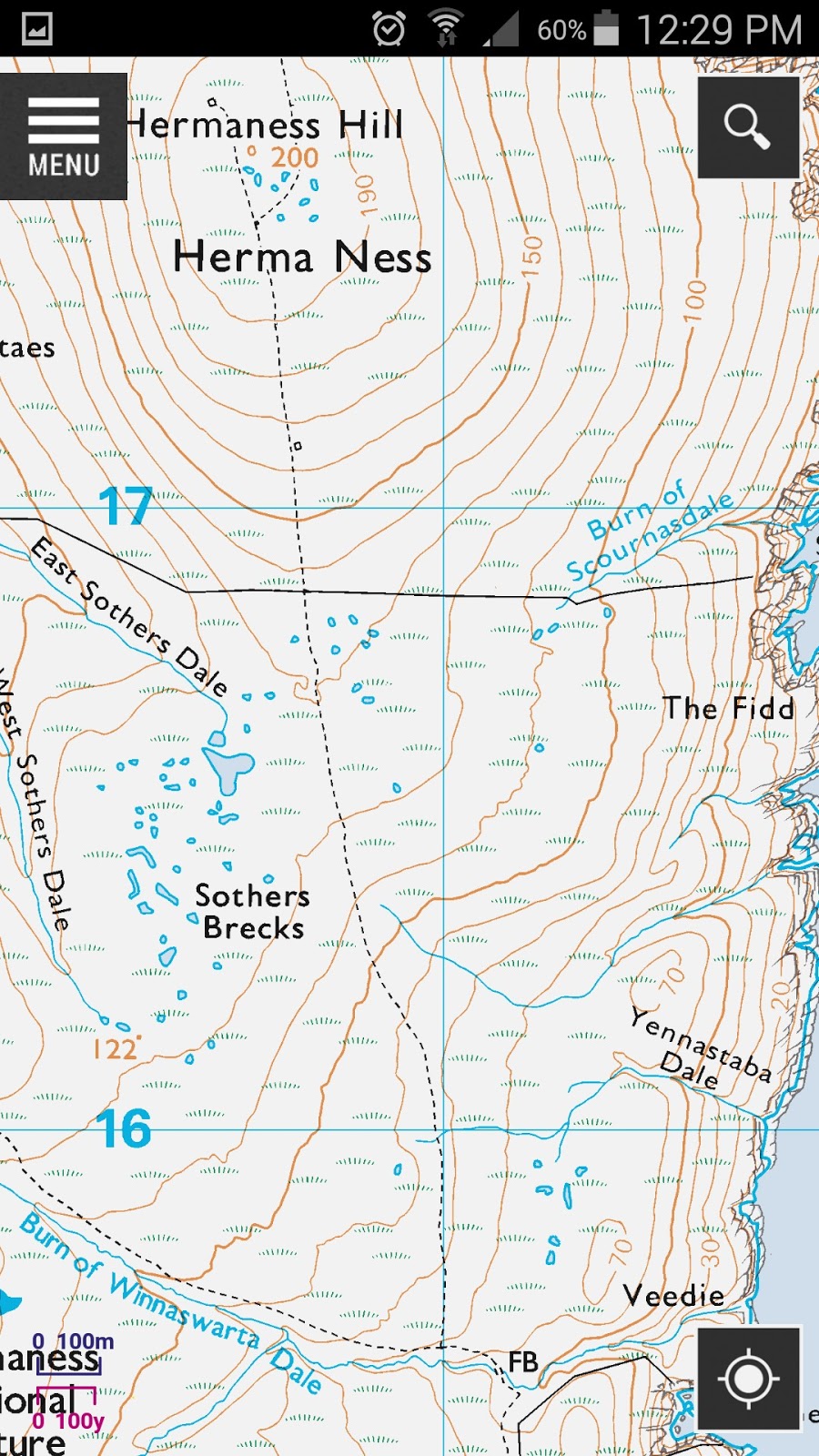


On top of Muckle Flugga is a lighthouse, the most northerly (and one of the most isolated) in the British Isles. It was built by the Stevenson brothers from 1854, becoming operational in 1858, and was automated in 1995 (see https://en.wikipedia.org/wiki/Muckle_Flugga_Lighthouse). Anyway, I want to take some clear shots from Hermaness Hill before returning to Fiona and making my way 'home'. That'll constitute my 'Muckle Flugga Adventure'. It might all sound rather a lonely endeavour, but I anticipate that each day from April to September parties of people do the same trek for the same reason, and I'm unlikely to be on my own.
This is just one of a number of day trips I've got in mind - not to mention evening explorations in Lerwick, subject to the usual murders and mayhem that BBC1's Shetland series suggests is normal. Well, who cares if bodies litter the alleyways. Bring it all on, asap.