Friday, 22 May 2015

The face of failure


This was me, last weekend, just before the moment came when I realised that I was not going to get to the top of a ladder. It was in an old tower. I did so much want to get to the top, and look at the view through a high circular stone window. But it was not to be. More on this story in a moment. First, what I did shortly before.

I was on a Saturday afternoon out in East Sussex. I went first to Bateman's, the former home of Rudyard Kipling at Burwash, and now in the care of the National Trust, which I hadn't been to for some years. It was looking very attractive.


You can see what a cracking day it was for fine weather! Quite a lot of visitors were over-dressed for the sunshine - for example a group of ladies I fell in with, who were on a coach trip from Sutton in south London, and had thought it might be a chilly day. Anything but.

Where next? Wanting to stay in the lush countryside, I decided to go southwards to Brightling and have another look at Jack Fuller's Pyramid in the churchyard there. Jack Fuller (1757-1834), a man of substance and social standing, is often referred to as 'Mad Jack', on account of the several follies he built in and around Brightling. See http://johnmadjackfuller.homestead.com/fuller.html. The pyramid is his mausoleum. There was a legend that when he died he was buried sitting fully-clothed at a table inside the Pyramid, with wine and a chicken dinner in front of him! But an opening-up of the Pyramid in 1982 established that this was nonsense, and that he was buried conventionally underneath the Pyramid. Nevertheless his resting-place remains an impressive monument, and a strange sight in a Sussex churchyard:


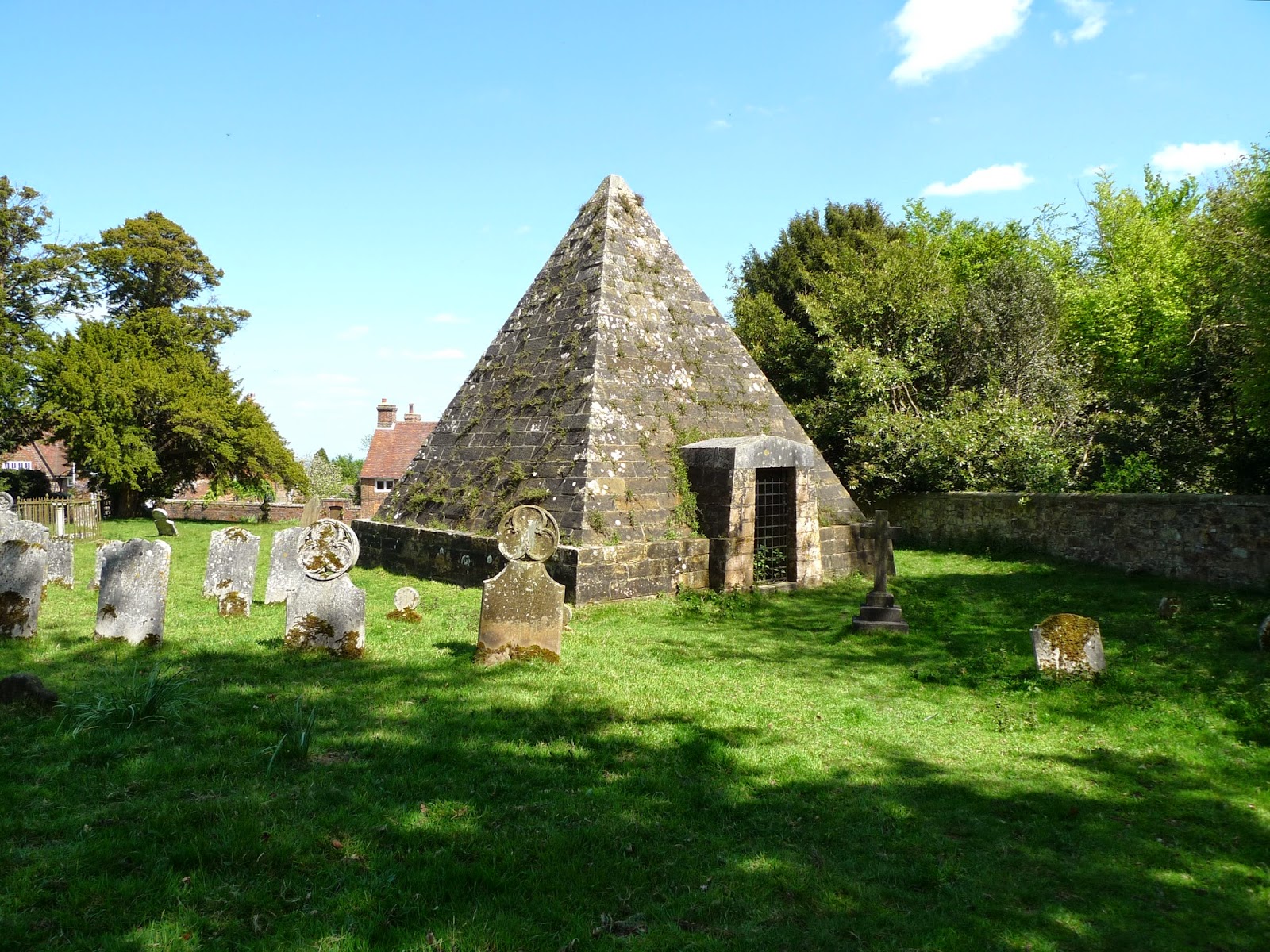
Looking through that outer iron grille, you see a sort of porch, and a window (barred with a diagonal iron grille this time) deeper inside the Pyramid, with total darkness beyond - perhaps this window looks into the room where (until 1982) legend asserted that one would see a skeleton at a table holding aloft a glass of red wine - a top hat perched on the grinning skull - and on the table, the bones of a roast bird on a plate.


I spoke with the churchwarden, who had been showing two women around the belfry of the church. He said it had been a surveyor appointed by the Church Commissioners who had gone into the Pyramid in 1982. Apparently the media were not let in, and we still have only the surveyor's word for it that Mad Jack was laid to rest in an ordinary coffin, and not upright with his right arm raised in a skeletal toast. I'm presuming that there are strict laws on opening up tombs, whatever the good reason for it; that only certain authorised persons can examine a tomb; and that they can do so only under a rigid set of regulations. Given all that, it wouldn't be so strange that the media were kept out, despite widespread public interest in the legend. But it only substitutes a conspiracy-of-silence theory for that old belief. To some it must seem clear that the surveyor saw something very odd, but wouldn't - or couldn't - tell!

One of the two women who had been talking to the surveyor before I came along had been carrying a brand-new Nikon SLR with a zoom lens. Leaving the churchyard, I saw a brand-new Nikon lens cap lying off the path. I picked it up and hurried off to where Fiona was parked, hoping that the two ladies had parked there too, and hadn't yet driven off. Well, there was a car in front of Fiona, and two persons were seated in it. Running as best I could towards them, I held up the lens cap. The woman in the driving seat signalled that I had her lost cap, and was very, very thankful to have it back. It wouldn't have been cheap to replace. My good deed for the day!

Leaving Brightling, I drove off down a lane and spotted a stone tower peeping out of a wood. It was probably another of Jack Fuller's follies. I parked Fiona and walked back to an open gate at a field entrance. A path went from there towards the tower in the wood. I took it.


The 'wood' was just a ring of trees. Within lay a well-preserved stone tower. There was an iron gate at ground level, and it was open. I could see an iron staircase leading up.


There were no notices to say what you could or could not do. I went inside, and started to climb.


The staircase went up to a platform. From there an iron ladder went further up, to a high circular stone window. I don't like heights, but it looked safe enough.


The view out from the platform was pretty good. Here I'm looking over to Brightling church:


Now for that ladder. The rungs were small, and I wasn't wearing the right kind of shoes. Oh well, here goes...


But it wasn't pleasant on my feet, and the ladder, secured at the top by a single bar that tended to pivot, began to sway from side to side as a climbed. It got scary.


That was as far as I dared to go. So near the top, but I'd had enough, and had begun to fear getting cramp in my feet. I descended, feeling defeated. You can see it on my face. The face of failure.


But a woman's got to know her limitations. I soon perked up. The afternoon wasn't over yet! I felt cheerful again by the time I left the tower.


Red summer shoes are nice to wear, but they are no good for doing anything out of the ordinary!

Thursday, 21 May 2015

Kerb Drill and other old-fashioned things in the Highway Codes of yesteryear

I was glad to discover a stash of old Highway Codes when clearing a section of my attic. The two oldest dated from 1962 and 1968. The first has a very period feel to it, reflecting another, simpler world in which car drivers were mostly men in sports jackets smoking a pipe, women wore long skirts and pushed prams not buggies, and children wishing to cross the road all wore school uniform and carried satchels. And everyone wore a hat.

Lets have a look at the Highway Code from 1962, which I bought myself, with my pocket money, when aged ten.


In those days, over fifty years ago, a personal message from the Minister of Transport and Civil Aviation would greet you on opening the slim volume. In this case, Harold Watkinson, the minister from December 1955 right through to October 1959 - but surely quite forgotten now - who says:

Accidents on our roads do not just happen; they are caused - sometimes by a faulty vehicle, sometimes by road conditions, but nearly always by human error. These mistakes, which take our lives, are made because in most cases we simply do not realize what we are doing until it is too late.

In other words, our conduct on the roads is not what it needs to be for present-day traffic. This Highway Code is for the ordinary road user; it sets out in the simplest language the code of behaviour which is a ''must'' if we are ever to make an impression on the totals of road accidents. If we could ensure that for the coming year every road user obeyed the Code, we should save a great many lives - perhaps our own.

To all who read this Code I would therefore say: ''Give as much time and thought to learning the Code as you would to anything else on which your life might depend. Contrary to what you might think, this Code is meant for you, not the other road user. Remember, it is your life you are risking.''

Now doesn't that sound like a well-meaning minister speaking? Note the earnest lecturing style, the wagging finger, the punctilious grammar, the double inverted commas, and the 'z' in realize, which is surely more commonly written with an 's' nowadays - at least by me!

That said, I rather like this edition of the Highway Code. It's short and sweet, and very clear about what one must do, although it omits the 'why' and is very sparing on the 'how'. It relies a lot on comprehension through drawings, but I think these work as well as photographs. Here's a short selection:


Ah, Kerb Drill explained in a few words at Rule 7! (The modern equivalent is the much more verbose Green Cross Code)


By 1962, most cars had the modern flashing lights we know today, to indicate left or right. But enough hadn't to give point to the section on hand signals. The section on motorway driving was a surprise - very few miles of motorway existed in 1962! Note the male trouser leg and boot pressing the footbrake on the yellow back page! Trousers with turn-ups must have been all the rage.

Oh dear, what a mess those old road signs were. I also found this little booklet from 1965, which gave details of a new type of road sign that would be progressively introduced in the years ahead. These signs have now become universal. (It's a rare treat to see a surviving old-style sign, and it's always worth a photo)


Strange to think that these 'new' signs have now been around for fifty years. They are everywhere, and in great numbers. We must be the best-signed country on earth. It would truly be a colossal task (and a hugely expensive one) to switch them to the other side of the road, as would be necessary if the UK ever adopted the continental rule of the road - driving on the right. Which is why I think that will never happen.

The next edition of the Highway Code in my possession was published in 1968. It has a much more contemporary look.


The front cover shows the 'KEEP LEFT' sign, and it's tempting to suppose that a subtle political message was being pushed at the public. In 1968 Harold Wilson's Labour government was in power. There was still a personal message from the Minister of Transport, Richard Marsh - also almost forgotten now - who held the job for a short while from April 1968 to October 1969:
 

He says:

This is a new and bigger Highway Code. It has been completely revised and re-written. We've tried to make it easy to read and understand.

Most people study the Code before their driving test and then forget it. That's a pity, because this is a working book. it repays continuous study. 

It deals with problems you will meet on the road, whether driving, walking or cycling. You may say ''I don't need a book to tell me what to do''. But there are right and wrong ways of dealing with hazards and emergencies and even normal situations on the roads. If everyone always did things the right way we wouldn't have all the accidents we do. The Code explains the right way.

The Code is not theory. It's a mine of practical, down-to-earth advice. It's a pocket life-saver. Please read it. Please do what it says.

'I will! I will respond to this very reasonable plea!' Thus spake the sixteen-year old me. Driving lessons were at least two years off, but I was keen to pass my driving test first time, and acquire some mobility and independence - assuming Dad would trust me with the family Ford Cortina! (It took me two attempts before I passed)

This 1968 edition of the Code lacks quaintness but is altogether a better guide to good practice, with more explanation of the 'why' and 'how' behind each rule. The drawings have gone - it's now filled with photographs, or illustrations based on photographs - on the whole successfully:


Toy cars, though?


The arm signal to a person in front of the car, when turning left, now requires the driver to whack a big hand across his passenger's face! And driving is evidently still regarded as a pursuit for men in suits.


Is it my imagination, or does that constable in the green section have a rather fruity look on his face? 'Yes, m'lud. The policeman on point duty gave me a big come-on. I felt obliged to respond.'

I won't trouble anyone with the later editions in my collection. Except to draw attention to this table, which reveals that the number of separate rules has grown considerably as the years have passed:

RULES TO HEED (excluding other material at the end of each version of the Code)
1962  94
1968  150
1978  185
1993  242
2014  307

No wonder passing one's driving test is now a major endeavour!

They cover everything in today's Highway Code. For instance, what to do when confronted with a lollipop lady using Kendo to defend the pedestrian crossing: